Monday, 31 January 2011

Way of the Dragon

"I see nothing more than you do. You look the wrong way."

Way of the Dragon was the first supplement/splatbook published for the L5R rpg. This post will be based on my 1st printing copy, so it may not apply to any other of the three printings. However I always try to find clarifications and errata and will make note of that in text.

As an aside I will make a small comment on the publishing order of the "Way of..." books.

It was awkward. I mean Dragon, Unicorn, Carb, are hardly the meat and potatos of Rokugan. I suppose that by starting with the aberrant clans they might be giving themselves the time to hit a stride and focus they were confortable with, but Crane and Lion are pretty much the clans that define Rokugan.

Having said that, the Dragon clan is my favorite clan and I'm sure this book had much to do with that.

In tipical RPG fare it starts off with a piece of fiction, which is actually pretty good, altough to say it starts with a piece of fiction is a bit misleading as 1st edition material had a strong narrative focus and much of the setting material was presented from an in-world point of view.

Case in point, the first chapter, an oerview of the Dragon Clan is mostly presented through letter annd anedocts by characters.

One thing that jumps to the eyes is how something aren't yet defined or might have been writen in isolation. As John Wick is listed as the primary writer with the contributions by other writers well defined in the credits page I must assume it was part of the "biased history" angle JW claimed to be aiming at.

Still, particularly as this isn't outright stated, it is a bit awkward to see Agasha being adressed as a male several times, or the points where Mirumoto is said to have no sons and then being treated to Yojiro. This one is more telling because the source cultures put a tremendous emphasis in lineage so this kind of mistake doesn't seem very realistic.

The second chapter goes more in-depth on the specific families, starting with the Togashi. Another thing I found here, and dearly miss, is the existence of family mon. Currently I'm not even sure all the clan mon have been printed in the books (Oriole, Bat and Ox might be missing), but family mon, other than a showing in Death at Koten have been completely absent.

Mind you though that I'm not particulalry fond of Dragon mon. They're based more on a chinese aesthetic that clashes with what I expect a mon to be. However most family mon are a bit too complex for my taste. Dragon mon just more so.

Oh, there are also rules for non-Togashi to have tattoos. Yeah it's a sore point for me that this was the last place where this has been considered despite the fact that, in fiction, many characters outside the order have been shown to have received a tattoo.

After the Togashi come the Mirumoto.The initial portion is a discussion on the Mirumoto armies structure and organization. This has largely been superseded now (altough, only on a web supplement, if I am not mistaken). Frankly I somewhat prefer if over the structures proposed in Way of the Lion and Masters of War as it seems a bit more feudal (not much mind you).

I was somewhat amused by the notion that the Mirumoto daimyo's income is a mere 20 000 koku per year. To put it in perspective, if Rokugan had the kokudaka system, he'd have to supply 400 samurai and 4000 Ashigaru. Far from the 200 000 samurai the Dragon armies are supposed to number.

Chui are supposed to lead 700 men with an income of 30 koku.

I must now remind myself that Rokugan is not Japan. Too bad it often doesn't make sense either...

The rank names which range from the modern to the gibberish also rake a bit. For someone who claimed to have 3000$ of books on samurai in his shelves it a bit disconcerting to not see John Wick use the ubiquous Kashira. It was fun to see Nikutai used. It does mean corporal, just not as in the military rank but rather as in body...

From then we move to history, and a discussion on Niten, with excerpts from the text. Here it is atributed to Hojatsu rather than Mirumoto. I need to check if this is recurrent because I was convinced it was from Mirumoto himself, despite the fact that this way it actually makes more sense.

Niten is clearly inspired by Musashi's Book of Five Rings, and I found it awkward that Kijome's commentary reads as tranlator notes, including word choices. Considering Kijome is suposed to be a near contemporary he shouldn't sound like he was translating from one language to another.

After the Mirumoto we move on to the Agasha. Finally I start seeing Agasha refered to as a she, which had me worried for a while.

For the most part it isn't a very interesting section other than the fact that their history is quite entwined with that of the Kitsuki (something I'm alway fond of because it creates context), and the description of the Agasha "foundries".

The Kitsuki section closes the chapter. It's agood read but there is nothing that truly stands out. It might be the origin of the idea that Rokugani only value testimony though.

The third chapter is the chapter on new mechanics and character options.

Six new skills are introduced. Ichi Miru, Nazodo, Mountaineer, Kagaku, Craft: Tattooing, and Craft: Mitsugusuri.

Frankly I'm of the opinion that skills should be wide, mostly available to everyone, and I'm very critic of expanding skill lists beyond corebooks, so I'm not very fond of this section. Mountaineer just dilutes Hunting, Ichi Miru should be a fucntion of the Kitsuki school and otherwise dilutes Investigation, Nazodo has the same problem being another form of Investigation, with some Divination thrown in. Kagaku and Mitsugusuri are adictions that make sense, but Kagaku shouldn't be restricted and be a craft skill, while Mitsugusuri (actually Mizugusuri) should probably be a function of the Agasha school. Unfortunately the Agasha school had already appeared in the corebook, and paths are still a long way from being created.

So all in all, Tattooing is the only skill I don't have a problem with...

There are also new advantages, Elemental Attunement, and Noble Birth. Remember, in first edition Ise zumi are not automatically samurai, they needed to take Noble Birth to be so.

As for Elemental Attunement I think it should either be open to any character, or be a function of the Mirumoto School.

There are also three new disadvantages, Ascetic, Enlightened Madness and Vanity.

Vanity is a roleplaying disadvantage, basically being a free point.

Ascetic is a disadvantage I have mixed feeling. It's a obvious take for ronin, but I'm alaways leery of how it is supposed to work in other situation. I suppose it might work as some sort of temple membership...

Finally the Kitsuki and Ise zumi schools are detailed.

The Kitsuki school is quite cool, in particular because it is a dramatic departure from the schools in the corebook. It has issues. Rank 3 and 5 are automatic sucess techniques with Rank 3 being more worrysome because there is no suggestion on how to deal with opposed rolls. Rank 4 is a technique denial technique, which I alaways find too fiddly for my taste.

The Togashi school is harder to grasp. On one hand it is quite versatile, but on the other the tattoos are generally weaker than techniques, or at least have significant drawbacks, and the Ise zumi will need to spend 16 points to get two extra tattoos beyond those given by the school. Frankly I don't remember how tattoos felt in play. They don't seem overpowered (far from it actually), but a few seem no-brainers in relation to each other. Ocean and Crane come to mind and Mountain seems a better option than Bat.

The chapter finishes with the Heritage Tables. On the positve side only one entry which grants 3 extra Void points per day seems overpowered altough there are a few other entries that might be strong depending on the interpretation, but the dishonorable past table will fuck you up if you're unlucky enough to roll there. Quite flavorful though.

The following chapter, the Who's Who, details a few NPCs, and introduces Ancestors in the sidebars. In my opinion Ancestors should have been in the character chapter and here should have been some of the gneric NPC stats that were put in the sidebars of the second chapter, but what do I know.

As for the ancestors themselves their backstory is very good and for the most part they are not abusive. With one exception.

Mirumoto.

Priced at 15 points and it is still a bargain for a Mirumoto bushi PC...

The NPCs are writen in the crisp, vivid style of John Wick. They are quite cool just with an hint of special snowflake here and there. I could lie without that, but surprisingly I'm not in the least bothered by Yokuni lack of stats unlike others. Gaijutsu's, Hitomi's and Tamori's tattoos bother me a lot more because they are a lot better than PCs can get. Yokuni being a god and working by GM fiat is small potatoes compared to that, in my opinion.

After the Who's Who there is a sample of 5 example characters. Supposedly they are ready made characters for players to take, but I suspect they were more fodder for GM ideas than anything else. Hell, the 5th character is nigh impossible to fit in a party.


Finally we have the Appendixes. The first is on Dragons (the creature), the second is on Kaze-Do, expanding unarmed combat rules.

The third appendix is on Agasha magic, with a new spell, Transform, which I was always wary about, a few Kagaku items, including black powder, a few nemuranai, of which the Agasha seeds and the Twilight lanterns left me very impressed, and Mizugusuri recipes.

The fourth appendix has a few adventure hooks, including Togashi Okkio which seems a proto-Kokujin (at least I think he pre-dates Kokujin), and a rough description of the Dragon provinces.

Between this and the next appendix there's also a map of Mirumoto Castle. I still haven't taken a look at the other maps, but this one actually disappointed me.

Finally we have appendix five which is a couple of CCG decks...

I would seriously like to know if anyone found this section useful?

Because for me, as a roleplayer it certainly did not, and I suspect it wasn't that useful for the card floppers either, but why waste a good synergy for network externalities...

Closing the book there is a reference sheet summarizing the new options and some clarifications, as well as a few character sheets.

All in all this is a solid first supplement.

Monday, 24 January 2011

Game Master's Pack- The Hare Clan

The first GM screen I bought was actually the 2nd printing with the Shadowlands scene, so I'm reviewing this screen from the PDF on sale at Drivethru RPG.

I assume the screen itself was thin card like the 2nd printing, but had, on the outside, the 1st Edition map of Rokugan and the Great Clan mon (as seen on the left), and on the inside a combat summary, the mass battle table, a TN table, skill roll and maneuvre summaries, Hit location tables, which are explained in the booklet along with rules for intant kills, but are actually wrong (were switched with one another), weapon damage, iaijutsu rules. All in all a very complete package, and in my opinion nicer to look at than the 2nd printing.

As for the PDF I will warn that while searchable it is not bookmarked nor hyperlinked. AEG seems to have revised their policy on PDFs with the new edition, but it is a shame that the legally available older edition PDFs don't have better fucntionality than those of a competent pirate.

As for the booklet itself it starts of with the Karma Rule. It's just a way to start with an experienced character based on the players previous character. Nothing much to be said, altough If I'm reading it right a character created with this rule might end up significantly more powerful than the previous character particularly if said character was insight rank 1 or 2.

It's followed by further elaboration on the GM advice from the Corebook. Again, I find the advice to deal with power players, well, Ill considered. Passive agressive behaviour won't make for good group dynamic.

There's also errata for the corebook.

Then come the new rules, Shadowlands Taint and Maho. Maho rules are interesting, being  quite different from the current incarnation. It is however yet another different sub-system and one that clearly was developed as an afterthought. Considering the importance of the Shadowlands in the setting it seems strange that Maho and Taint weren't part of the core rules to begin with.

The spells included are mostly ok. Oni summoning though as no suggestions on how to be used so it feels like it's mostly a way to taint someone.

Finally we have the adventure itself. I don't want to give much away, but I quite like it even if it feels a bit disjointed at times. The weak link in my opinion is that while the setup lends itself to a court/intrigue game, a third of the adventure is spent on the Shadowlands with a plotline which is completely tangential to the interests of the PCs. There is also little advice on running mass battles which could come in handy for the last part of the adventure.

Personally I would fork the Hare Sword recovery into an independent adventure, and focus more on Lion-Hare-Scorpion-Kolat politicking.

However I usually love Greg Stolze's work, and this is no exception. He created the Kochako family for this adventure, a poison, put the proto-Usagi technique, there are floor plans for both Hiruma castle and Usagi castle. Other interesting thing is that the Hare general Takeshi seems to have a variant on the Crab technique.

All in all this is worthwhile product.

Sunday, 23 January 2011

Previews at AEG

I've been looking at the Emerald Empire previews at AEG.

Interesting, altough it didn't made me want to buy the book. There's too much stuff there that is unlikely to fit my taste. I'm afraid they might have just reintroduced Dojo rules and Way of the Daimyo was a mixed bag for me, so I'm not that psyched about it being updated.

There's nothing hinting of vassal family content, either.

I was however pleasantly surprised by the preview of Enemies of the Empire. I had discounted it as being an expendable book, but the preview made me reconsider my opinion. I may very well come to buy it.

Thursday, 20 January 2011

Legend of The Five Rings Roleplaying in the Emerald Empire- Musings

These are just a few strings of though that came to me while reading the first core book, but didn't quite fit in the section read throughs:

  • For a game based on the Five rings, they have actually little impact. Only Earth and Void have specific purpose in the rules, with Insight and spellcasting making sure the other rings must also be considered. Water would be tied to movement from 2nd Edition onwards. Air and Fire still don't tie to anything, although the Stance and Kata rules can be seen as covering this. I personally think  that tying Air to Initiative instead of Reflexes would have been a good start. Other thing that could have been done would be to do away with traits altogether and use the Rings, but this would raise the question of skills being considered even less useful. Hard-linking rings to skills migh solve this but it become an extensive re-design.
  • No movement rules. They were only added in Clarification/Errata. Personally I'm not overly bothered by it as I took a more narrative aproach, and in situations where movement is important we have the Athletics skill, but for those more interested in a tactical or gamist aproach to combat this would be lacking, in particular because there are no rules for multiple actions.
  • Honor. On one hand I found that the book decidedly wasn't that focused on honor being an integral part of roleplaying in Rokugan, so the vagueness of the Honor rules isn't that bad. On the other hand the honor system is lifted from the Passion system of Pendragon (where BTW there is a defined Honor Passion), and badly lifted at that. Unfortunately this is something that would become a bigger sore as the line grew.
  • No multiclassing. Considering that there are only two classes, and that shugenja are supposed to be taught, not born, it's a bit annoying, more so if you consider that these are supposed to be religious prayers. But I guess much could be said of the non-handling of religion in RPGs.
  • On a related note. spellcasting being class based, in a system that is otherwise very heavily skill based.
  • The use of a supplement threadmill approach. I'm not exactly against this business model, but AEG was being rather heavy handed in its use.

Legend of The Five Rings Roleplaying in the Emerald Empire- Book of Void

We now reach the last chapter of the first L5R core book, the book of Void.

Again we begin with a small fiction, now with the twist that partway the POV changes to that of an ongoing game session.

There is a short campaign construction discussion. It is interesting that from the start it is assumed that the GM will limit the campaign compared to the stance taken in the 4th Edition.

Then comes the advice on actually running the campaign which is actually pretty good for the most part, and clearly aimed at the beginner.

However, John Wick has the stance of punishing a player in-game, for out of game actions. See page 170 for example. The irony is that the GM in that first example doesn't even need to cheat for the player to suffer the exact same consequences, and by cheating it's probably making sure what we are told in pages 167-168 (having fun is the most important) doesn't happen.

A disruptive player is disruptive regardless of the in-game consequences you dump on their character(s).

After the campaign and game mastering advice there are a few non-stated out NPCs, a few magical items, and information on the ninja.

Frankly the ninja section seems a badly though out bolt-on, if not an outright comercial to the Way of Shadow supplement (nevermind that the Way of Shadow didn't exactly include what they tell us would be included herr). Way of the Crab and Way of the Lion also get the same treatment.

Oh, yeah, the insistence that Rokugani characters are absolutely convinced without the shred of doubt that ninja don't exist is also boring as well.

And unnecessary.

And not helped by insisting on making a ninja section, firmly putting an elephant in the china shop when he wasn't there before...

After the much to big ninja detour we have a small bestiary.

This section aslo includes several adventure seeds in the Challenge-Focus-Strike format, and a complete adventure.

I found the CFS seed fine, but the adventure while interesting has some flaws.

For one, it forces players to play pre-gempukku characters.
It also puts a Fortune immediately as a patron of the players.
Considering it is an introductory adventure and the characters are supposed to be children it also is very heavy-handed in the consequences for some failures.

If you fix these aspects it is a very fine introductory adventure for both the system and the setting.

After Ceremony of samurai we are treated with something I've come to realize we are sorely missing from 3rd Ed. onwards.

Maps.

Castle maps, geisha houses, temples, villages, you name it it exists.

Finally there is the actual map of Rokugan and a travelogue of locations.
One thing I liked here, and that returned in 4th Edtion, was how the great clans had borders that left large gaps of unaligned lands.

There are also some roads marked, which is a nice touch, as well as sea lanes, which we probably could live without.

There are a few mistakes, some key numbers are repeated, others are missing (or migh be in the creases of the pages), but nothing otherwise obvious.

My main impression here was how mind-numbingly long and baroque the toponyms are you won't find any Osaka here. Hell, you be lucky to find an Okinotorishima....

And with this I ended reading the first L5R rpg book ever. There were a few tables adds, reading suggestions, and the usual author notes, but nothing noteworthy (pun not really intended), but there is no point going over that.

I will do a small post-read analysis of somet hings that came up while I was reading but didn't fel right to post just yet, and then I'm going to start on the 1st gamemaster pack.

Legend of The Five Rings Roleplaying in the Emerald Empire- Book of Air

First things first, I should start with a disclaimer:

Magic bores me to death. I suppose that which attracts me in fantasy is what could have been or maybe the what if.

Magic though, at least the way I've seen it done in most books and games, just plain bugs me, in particular when conbined with historical stasis.

Sometimes I'm surprised I'm not that much of a fan of science fiction either, considering it usually handles these aspects much better than fantasy.

This little rant only means that I'm reading the Book of Air, aka the magic chapter, and, well, it feels like work, and not just any kind of work, but the mind-numbing, wage-slave kind of work.

Almost at least...

 Like the previous chapters it begins with a small piece of fiction. Again, utterly forgettable.

It moves on to religion. A lot of what's in this section as been superseded by changes in the setting, and it's not very deep to begin with, but the only thing that annoyed me was when we are told that because spellcasting looks like maho peasants fear shugenja...

Right, so religious ritual looks like ilegal sorcery, which makes priests feared, but still very important because of their social role.

If you thought that phrase makes no sense, that's no coincidence. Mind you that they started off as if shugenja were scholars, which would make this distinction much more sensible.

One thing that was changed, to my pity, is that in 1st Edition, shugenja were clearly taught rather than having innate ability. This made their religious nature far more believable without sacrificing any other interpretation.

Following this overview we get the spellcasting mechanics proper and the spell list which finishes the chapter.

 The first thing I noticed is that I really liked the streamlining that was made in 2nd Edition.

That's right, I'm praising 2nd Ed. for something.

The main problem, for me, and this is something I've already mentioned about my personal preferences in 4th Edition, is that Magic is not very transparent, particularly when compared with the rest of the system. There are a lot of fidly bits here, with mastery level being a major culprit.

At this point I'm remembered that 1st Edition magic was overpowered, but I've got to wonder if they noticed one small detail:

In first Edition rest only recovered 1 slot per element. It could take many days to recovel all spell slots.

Now, this is a rule that I don't like, but I would like to know if those thinking Magic was too powerful took this into account, because it makes spellcasting a much bigger trade-off.

 One thing that might also escape notice is that alot of these spells were lifted directly from the Bushido RPG. This is something about which I have mixed feelings. A problem I sometimes have with RPGs, is that they become somewhat self-referential. Take the proliferation of elves and dwarves just because Tolkien did it, but as codified by D&D (which means they are not much like Tolkien). Something appears somewhere, and all of the sudden it appears everywhere...

This is not necessarily bad, there is something to be said about familiarity, and I'm certainly not the type that defends the mantra that new or different is always better, but at times it feels just fucking lazy and unimaginative how these thing get repeated, and in this case they don't even credit any kind of inspiration from the original.

Curiously, I found no traces of D&D, the usual suspect, being copied...

Wednesday, 12 January 2011

Legend of The Five Rings Roleplaying in the Emerald Empire- Book of Fire

Moving on to the Book of Fire which is the rules chapter.

As you probably can guess by now we continue to be treated to Ginawa's adventures, now with Lion and Crane caricatures and Turi name-changing Gohei getting killed (He got better), before we get to the mechanics proper.

For the most part there isn't much to talk about here. The game was clearly rules light so there isn't much verbosage being spent. It is however very concise, amd it definitely make the system seem very intuitive.

One thing I've noticed is that the Void rules contradict the Meditation rules on recovering Void points.

The dichotomy between skills and traits is also adressed, altough it read a bit like rationalization. It does however mention the wound penalties that are on of the strong balancing factors in 1st edition, and that were dropped after it.

Interestingly, this seems to reinforce the idea I had that 1st Edition was more transparent than 4th Edition L5R in its mechanics. I suspected it might have been a consequence of the time I've been away from the game, but now I'm not so sure...

Another thing I didn't remember was that unarmed attacks were rated at 1k1. I want to see how Stone Hands works with that in Way of the Crab...

It is also interesting how there are more than a few exceptions spread through the system which is a bit at odds with how simple and intuitive it otherwise is.

For example, Initiative is merely rolling 1 dice and adding Reflexes. This may very well an atempt to reduce the importance of Initiative, and minimize the death spiral:
  • It means Initiative is not affected by wounds.
  • It means the synergy between Defense and Initiative isn't as big as in later editions.
  • High Reflexes characters can't depend as reliably on Initiative, more so as it is rolled in every round.
Another such exception is the Defense skill. Again I suspect the different mechanic might be an atempt to prevent the death spiral, however I think in this case it fails.

Under 1st Edition the standard use of the Defense skill was that in full defense the attacking character add to drop all dice that rolled lower Reflexes+Defense skill, which were probably the dice the attacker was already going to drop. Even after errata that changed full defense to become a Defense skill roll (no trait, just the defense skill) keeping a single die, that was added to the normal target number, which averages 11.49 at Defense 5. Not much considering you lose your attack, and very little once you do get multiple attacks, so there is very little incentive to enter Full Defense.

Mind you, this is not necessarily a fault, in that samurai swordsmanship did tend to favour striking first and in a way that the opponent could not retaliate, but gamewise it would probably better represent this by making attacks simultaneous, or pure and simply make full defense a viable tactic.

After the combat mechanics are explained there is a sample skirmish, that is quite enlightnening, showing even things that aren't directly stated in the rules. I'm going to re-read all equivalent examples in the later editions to see if they are as effective.

The next section is on mass battles. Nothing outstanding here either, I do think the 3rd edition adaptation is more "complete" so to speak.

Finishing the chapter we have a guide to Glory rewards and losses, and the catalogue of weapons and armour.

Again I don't have much to say about this section, other than the fact that no guide for honor is given should be seen as an ominous sign.

And I also have to admit that the bit of armour porn at the end did manage to arouse me a bit.

Seriously the writers did want to show a bit of armour for the sake of armour...

Don't loose the book of air on the next installment.

Tuesday, 11 January 2011

Legend of The Five Rings Roleplaying in the Emerald Empire- Book of Water

The second chapter is the book of Water, which is the character creation chapter, and like the book of Earth, begins with fiction depicting the continuing adventures of Ginawa. Again there is nothing memorable here.

With that out of the way we get to the meat of this chapter, character creation.

It starts out with character concept using the Game of 20 questions. Now, I don't have anything against the 20 question per se, it's just that they don't necessarily have much to do with character creation.

Sure, it can be helpful if the player has no idea whatsoever on what he is to play, but even then they don't give that much aid to a newbie player or to those with little knowledge of the setting.

Now if all the question had direct impact on character creation, in a similar way in which most FATE variants do, it would be worth it, but this way it is just encumbering the player at the creation phase with thing that aren't really needed. or that arise organically from play. I would probably cut down the Game to 5-6 question and let the rest come from play.

Following the 20 questions, a few archetypes are described, with their benefits and pitfalls. Bland, but useful.

At this point the mechanical information starts to be more substantial, with an explanation of the elements on the characters sheet, but before going into that I will point out the sidebar on pages 54-54. Now start a drinking game on how many official character names break those rules. Or rather, don't. Results can be disastrous...

Returning to the issue at hand, it is given an overview of the rings and traits folowed by a shorter overview of skills, clans, families and schools.

Only after this overview do we begin with actual character information.

One thing that surprised me me was how Honor loss was handled. Every time a character fell bellow a rank he'd go to the halfway point in that rank. So if Isawa Shigeharu was Honor rank 3.1 lost 2 honor points he'd go to 2.5 Honor rather than 2.9. Apparently when gaining Honor it reveive a bonus of 3 Honor points altough the writing isn't very clear here. So if Mirumoto Naomasa had 1.9 Honor and gained 1 Honor point, he'd be at 2.3 honor rather than 2.

I don't remember ever using this rule, and I'm a bit surprised at it. I'm also surprised on how Insight and Glory are described in so similar a manner.

One thing I do remember, and I'm very glad was changed was the difference between character points and experience points. Traits and skills had different cost depending on wether you were upgrading them on character creation or in play, and as I prefer to view CPs as XPs for the character's life before play, the different currency wasn't much to my liking.

However I've also noticed something. Much has been said of how inportant traits are in relation to skills, but looking at the costs this seems overstated. Relatively speaking Traits are actually cheaper in 4th Edition than they were in 1st Edition. Character creation does favour raising traits instead of skills as does the the Insight system, but for advancement skill are much more effective unless compared to Void which is a ring that is valued as trait. However as Void's main bonus are the Void points this might not be too bad.

Thematically this is interesting as a optimized starting characters will probably have a good dose of natural talent, represented by traits, but will then develop skills, and their attunement to the universe, as represented by Void. Considering starting L5R characters seem to be teenagers this looks appropriate.

After the character creation overview we have clan outfits, an example of character creation, and the equipment section.

If you went hum?! there, it wasn't an accident.

The character creation example is great, but for the love of God I don't understand why it was crammed between two equipment sections, particularly when the clan outfits are redundant.

As for the equipment section I must give props to art direction again. Almost every equipment item is illustrated.

After the equipment section came skills. It's a list tipycal of the period, mechanically light. The only thing that caught my eye was Herbalism and Medicine being specifically stated has being the same thing. An attentive GM can take care of that, but it felt redundant.

Same deal with the Advantage/Disadvantage sectio. Sensei, True Friend and Ally feel redundant, altough this might be a case of hindsight. On the Disadvantage side, Compulsion, Phobia and Chemical Dependency suffer a bit from the same problem, as does Black Sheep and Social Disadvantage. Other than that I found no obvious problem, altough I'm coming back to this section once I read the Fire book in more detail.

Following the Disadvantage sections we find the Clan spreadsheets that are awesome, in style at least if not in content (Who am I kidding?). Each two page spreadsheet (1 page for ronin) has a stylish illustration, a summary of character creation, clan overview, clan mon, opinions on the other clans, bushi and shugenja schools for each clan, outfits and three families.

 This is where I find most to criticize though. Like I said above the outfits are redundant, and, as per errata, when they differ, the correct outfit is the one in the clan sheet, so the space used before the character creation example was a waste of space. More important though is that only 3 families per clan are included when the space used to describe them is about one line. This is made more egregious by the fact that at this point all the missing families with the possible exception of the Moto were already defined in the storyline (and several are mentioned in the clan overviews).

It gets worse if, like I did, one goes through the trouble of reading through the PR stuff, clarifications, and whatever else can still be found. Many of these things were not left out by lack of space or some other reason , but clearly as commercial/marketing strategy.

Very disappointing.

I'm not commenting on the schools themselves, as, due to the several iterations they have gone through, I don't remember how they feel in play.

It's clear shugenja shouldn't be unbalanced as there isn't much variation between them, but I can't really remember the bushi schools.

Bayushi being initiative based probably ruled alongside the Mirumoto vorpal blender.

Ok, I'm going to open an exception to talk about the Dragon, as both the Agasha and Mirumoto school and families are potentially abusive.

Both schools allow choosing the trait bonus, and the Mirumoto family does as well. This invites trait optimization as I've mentioned above. More inportantly, the built in control is that the Mirumoto school only gets 6 school skills, and the Agasha school 5. I'm not sure when did the Agasha got their 6th and 7th skill, probably sometime during the second edition, but the Mirumoto only got the 7th skill in the 4th Edition, long after they lost their trait choice.

Finally, on what would be the ronin's spreadsheet second page there is a listing every skill, advantage and disadvantage.

Next up, we'll move to the Book of Fire.

John Wick

One of the things I've been doing while reading the books for this blog is going through the internet in search of old clarifications, interviews and errata for the RPG. Get a pulse of development and fandom, so to speak.

There's been a lot of archive binging.

One thing I'm surprised is how John Wick's online persona came across as being as complete asshole.

And I don't mean by that that he had a strong authorial voice.

I mean that he came across as being a complete bastard. Hell, those that think him annoying today would probably go batshit insane at his posture back then. The 2010 JW is a completely mellowed out version of 98-99 JW. If I had acess to the internet and was into L5R he'd might be able to drive me away. I'm not even sure I'd find him more palatable than one AEG's current moderators, Dace, which I can single out as being strongly responsible for me to decide to completely drop out of L5R nearly 3 years ago.

I won't even compare JW's online persona with his writing persona...

I am however going to put some of the archives I've been going trough in the Links sidebar.

Thursday, 6 January 2011

Legend of The Five Rings Roleplaying in the Emerald Empire- Book of Earth

The first chapter proper, the Book of Earth is the setting chapter.

It starts off with a competent but forgeatable piece of fiction featuring Ginawa, with sidebars repeating part ofthe Introduction's Glossary, which in my opinion makes it even more expendable, and the disclaimer that Rokugan is not Japan.

I suspect I'm going to have a lot of fun with that disclaimer...

After the fiction snipet begins the Gaijin's Guide To Rokugan proper, in narrative format starting with the creation myth.

The initial part of the myth is clearly identifiable from chinese and japanese creation myths but with the twist of the Three Sins, that forms the basis of Nothing's origin for those familiar with it.

It's also simplified in that Amatersu and Onnotangu directly replace Izanagi and Izanami. Nevertheless, so far, it seems closer to the Japanese myths than the more recent retellings.

It begins to differ significantly with the introduction of the Naga, and, more importantly, with the introduction of the Olimpians, with Hantei taking on the role of Zeus.
Young Fu Leng

Incidentally there is a nice illustration of the celestial family on page 18.

If you ever wondered what Fu Leng looked like as a kid, search no more. Ain't he a cute little tyke?

At this point we start moving from creation myth into historical narrative, with brief overviews of the clans being given as well on geography.

Incidentally, Shinsei is awesome. Check page 20 if you don't believe me.

The next big section of the guide is on culture. The celestial order is explained, with the different castes detailed.

Now, I have a problem with the Rokugani caste system, because their cosmogony doesn't doesn't really justify how strict it is, same as the blood taboo. It's one of those things were the designers changed one element of the source material without really thinking on how it would affect those that stayed the same. I can think on ways to reconcile these discrepancies, but it's still a sore spot.

Women's roles are also discussed. In this edition there is a stricter definition of roles comparing with later edition, altough not as strict as the inspiring societies usually were. I tend to prefer it this way, but again it is a place where the changes in mythology can justify it going either way. I tend to deal with this in family by family basis. I do have an extreme distaste of the marriage customs as they were lifted wholesale from japanese culture and are very hard to reconcile with Rokugani history.

After women's role the lifes of samurai and farmers are detailed. There isn't much to point out here, but it is a good place to note on how effectively the sidebars are used, at least in this chapter, always full of small cultural detais.

Then we have on of the favourite subjects of L5R, the economy. It's actually not too bad, just very incomplete and unusually focused on carpenters...

The food section is other that it isn't as restricitve as I remember. It could have done with better editing and I had to smile when they say that milk is more valuable than the cattle's milk (let's just say that if Rokugani are human, or even merely mammals, there is a high probability they are lactose intolerant as adults), but there are some allowances for the eating of meat by samurai.

Considering Rokugan is far more landlocked than Japan, and that some of the cultural taboos against eating meat don't make sense in this context, this allowance should be bigger, but it is stil better than I remember.

Clothing and housing are up next, and here I find something I've been missing in newer editions of L5R, or other RPGs, and hadn't even noticed. Art that isn't character or action oriented. I understand why AEG took to recycling card art, it makes sense, but for the CCG it's usually important that the art be dynamic and/or character focused, and I've noticed that many RPGs have had their art focusing on characters and actions, maybe in attempt to establish some kind iempathy/dentification with the prospective player, which is all fine and well. However, I think this come at the price of leaving the setting "shrouded in mist" so to speak. The black and white drawing of houses, castles and people in this section lead me to imediately imagine busy streets full of peaple and rows of houses.

Those pictures helped the setting come alive.

This leads us to the Bushido section.

Now the Code of Bushido as the Rokugani know it was not defined at this time. That happened either with the first travelogue, or with Way of the Lion whichever was published first. Here we have something which shows more of the societal effect than scriptured dogma.

I suppose either way is ok, and they aren't mutually exclusive,but since Rokugan's brand of bushido seems to have been largely lifted from Tokugawa's household code it's a times... "iffy".

I particularly like how Sincerity and On are treated here which put's it in stark contrast with the later assertion about Rokugani judicial system that it is completely testimony based. None of that silliness here.

So far this has been a breeze to read through, but I've already hit two facepalm moments. One was a bit on sword etiquette on how katana are kept in the obi blade down so that the saya does not dull the blade. The other, more problematic, in my opinion, was the revenge section, which highlights the anachonism stew approach L5R takes. Again it is not something that can't be reconciled, but it was clear that the writer wanted to include the revenge theme in the setting, but didn't want give carte blanch to the potential abuses that might lead.

By the end of the chapter we have additional information on the political and justice system, including how much magistrates should earn. I was quite surprised to find an Imperial Magistrate should have a stipend of 2-4000 Koku, and a clan magistrate should have a stipend of 700-2000 Koku. Also it's mentioned of karo actively leaving their lord due to lack of reward.

The last section of the chapter is a quick rundown of the game system. Personally I think this should have been part of the Introductory section.

Wednesday, 5 January 2011

Legend of the Five Rings Roleplaying in the Emerald Empire- Introduction

"We tell tales of heroes to remind ourselves tha we can also be great."

The book that started it all, or it would be if my copy wasn't a 2nd printing. I'm not sure what are the differences between the four different printings (and in fact I was told that they could be quite substantial), so I won't claim any of my observations to be universal.

Starting with the physical object, L5R is a 256 page perfect bound hardcover. I got my personal copy 2nd hand in late 2001, early 2002, and I must say it withstood the ravages of time quite well, only the glossy clan sheets have become detached (which is apparently a common complaint), but otherwise it is quite intact.

The cover itself is... Well, atrocious, as you can see to the left. I have a hard time finding a better example on how to fail in conveing what your setting is and being at odds with it. Fortunately the inside artwork is far, far superior.

There is a very good table of contents, which makes up for the lack of an index (which could have easily taken the four pages devoted to adds at the back of the book).

The book starts off with an small introductory section of about five pages with the usual "what is roleplaying" section, followed by a small primer on the "Rokugani" language (which then is usually ignored in the game and fiction...), and then ending in a glossary of "Rokugani" terms and stock phrases.

Personally I'm a big fan of translation convention, I'm a Portuguese guy, playing an american RPG about fantasyland samurai. We should assume that the characters coming from a shared cultural universe are capable of understanding each other, so I don't see much point to the waste of space in stock phrases for the sake of a supposed brand of flavour. Common loanwords, and names are of course exempt, and anybody knows that some jargon will inevitably seep into the language, but that's it.

Next up I'm going to take a look into the Book of Earth .

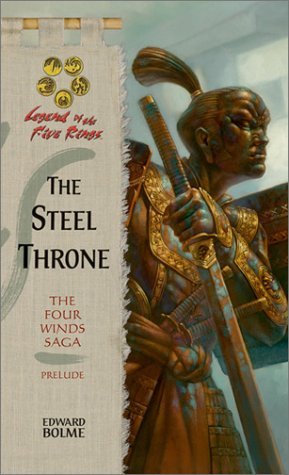
The Steel Throne

The Steel Throne serves as a bridge between the Clan War saga and the Four Winds saga.

This will be the last novel I will review for a while as I still don't have Wind of Honor or Wind of Truth.

The setting of this novel is the War of Spirits, a period which I was always very interested in but never got much development because of a lawsuit. Apparently, though, next year AEG is going to release a sourcebook, Imperial Histories, which will detail this era among others.

I'm actually a bit pissed off I completely missed this. I don't know if I had any chance to get selected or at least be a running candidate, but I would have liked to try...

As to the novel itself, I was very pleasantly surprised.

Characterization is very good, Hantei XVI, Toturi, Hida Tsuneo and Akodo Kaneka being particularly well done. Tsudao was the only character which got altered substantially from her traditional depiction.

In this novel she's dumb as a brick... And I don't mean in the Good is Dumb kind of way, but rather the Full Retard kind of way...

Incidentally, Kaneka is awesome in this novel. Too bad he ended up in Jesse Lebow's hands, then fell prey to AEG's "Rokugan must have a Shogun" fever, AND then had a bridge Khan dropped on him. Alas poor Scrappy...

It is not without problems though. The novel spans 20 years, roughly one per chapter, which means that the action feels disjointed at times, and some plot  are left underdeveloped or unexplained. The Dragon clan involvement is also awkward with Tamori's power seeming to be a bit too widespread.

Then there is Kitsu Motso's death... I'm still undecided if self-beheading by spinning no-dachi is awesome, or just really dumb.

All in all is a fairly enjoyable book, and if your interested in the War of Spirits it will still be the only source for a while.

Sunday, 2 January 2011

The Lion

The final novel in the Clan War, The Lion wraps up with the Day of Thunder.

This update took a bit longer than usual because of the usual holiday rush, and because the novel itself is not that interesting.

Mind you I don't mean it's bad. It's just so incredibly average you don't really want to keep reading other than to ocupy your time during a commute or something like that.

You can also do a drinking game with it. Drink every time lion-headed katana...

It does get better towards the end, during the Day of Thunder proper, but up until that point it seems as nearly every moment of character development must come during or after a fight which make the first two thirds of the book a bit disjointed because it looks like battle scenes are being thrown around just to set the mood.

Comparing it with the other books in the saga this one is probably the middle of the pack. Undoubtfully better than the The Unicorn or The Phoenix, it struggles with The Crane depending on the readers particular taste, but definitely worse than The Crab, The Dragon and The Scorpion.

Sullivan seems to have completely overcome his fascination with natto though.

Saturday, 18 December 2010

Legend of the Five Rings Diskwars

In my, geeky, hopeless, money-sucking, obsession to chronicle the evolution of L5R, I managed to get my hand on a few sets of Legend of the Five Rings Diskwars., and I've also got to play a couple of games as it is.

I have a recollection of Diskwars being somewhat big for a couple of years back in 2000-2001, but I had never saw the L5R version, only becoming aware of it several years later.

Diskwars might be seen as a low cost wargame. Cardboard disk of different sizes  are use to represent military units. Each disk has an Attack, Defense and Toughness value which are used to resolve combat. Since disk size affects both movement and combat, this reminds me of Song of Blades and Heroes a lot, and I have to wonder if SBH might not have been somewhat influenced by it.

Personally I'm more of a miniatures gamer because I like the painting aspect of the hobby as much as the gaming aspect, and the collectible aspect of this game would drive me bonkers (I suspect that's the reason I never got into any kind of CCG), but I have to admit I had fun playing it.

There were two "Editions" of the game, Imperial and Shadowlands, in reality rather an Edition and an expansion. In Imperial Crab, Crane, Dragon, Lion, Phoenix, and Unicorn were the available factions, with the Scorpion and Naga being introduced in the Shadowlands expansion.

The distribution model was a series of starter sets for each available clan, and booster packs.

Clan sets came with 5 fixed "flats", 2 common flats, and an uncommon flat. Each flat had an average 4 or 5 disks depending on disk size. Booster packs came with 4 flats, 2 common, an uncommon and a rare. Shadowlands worked slightly different, with a pool of 60 flats, but I suspect the difference is more cosmetic than anything else.

Rules are the same between both edition, Shadowlands just clarifying, adding errata and two more scenarios rather than changing anything, They probably are the same from basic Diskwars as well because there are few intances of different namings along the rules, e.g. Daisho was probably Swashbuckler, Counterspell was Surge and there are other. Many of these disappeared in the revision from Imperial to Shadowlands, but not all of them.

The rules themselves are pretty simple for the most part. I felt duels needed better explaining but I'm not sure how they would work in actual play as there was no way to initiate a duel with the disks we had. We did a mock up and my doubt is if hits incurred in the duel would carry over like missile or spell hits. I suspect it does, but it would be nice to have confirmation.

Most any other issue would likely stem from wierd disk interactions, but most disk are fairly simple so I don't know if there are obviously broken disks. In our games Soshi Bantaro did very well against the Lion army which had three shugenja forcing me to adjust my strategy, but when I played Crab with a single Kuni Yori, he didn't bothered half as much. It might just be that Scorpion pairs well against Lion, but not so much against Crab. Then again I managed to win with Lion (in no small part due to the Death Seekers ability, which also raised questions) but lost with Crab (probably because I took few elements which made the Scorpion abilities more effective).

Storywise there isn't much to add as it uses the Clan War Storyline, and only reprints one fiction from the ccg expansion of the same name in each rulesheet. In the Shadowlands expansion some of the flats also had flavour text.

The use of the Clan war storyline actually surprised me a bit, because when this game was published it had already been  wraped up for two years, so there is no reason why they had to use it. Why not explore other possibilities?

Come to think of it the same was pretty much true of the Clan War miniature rules. Every L5R branch into another market used the same storyline. I suppose that it's was a way to spare money in art and fiction, but why risk saturating the consumer with a rehash of the same basic story? The miniature game I can understand as it was released earlier, was certainly developed while the Clan War storyline was being worked and was certainly a far more complex project than L5DRW that potentially had direct ties to the RPG.

However this game was almost certainly developed with little effort. The rulebook like I said before is probably just slightly changed from the FFG original, I wouldn't be surprised the same happened with some disks, and I am absolutely sure it happened with the spells. The recycled art is no impediment and there is some art that I think is original (Iuchi Juoseng is awesome, BTW), so all in all tthere was little to lose in taking that risk here.

This is probablya moot point though because when AEG recovered all IP rigths from WotC L5RDW would probably still be one of the lines that would make sense, from a business standpoint, to cut.

Anyway here are the armies we used to test the game:

Lion Army:
Ancestral Home of the Lion
Ancestral Sword of the Lion
Scout x3
Matsu Agetoki
Medium Cavalry
Kitsu Motso x3
Akodo Death Seekers x3
Morito Tokei x2
Kitsu Toju
Gift of the Wind x2
Stiffling Wind
Gust of Wind
Essence of Water
Energy Transference
Mighty Protection x2
Delving the Earth x2
Earth Stagnation x2
Strangling Root x2

Total: 148 pts.

Scorpion Army:
Ruined Fortress of the Scorpion
Broken Sword of the Scorpion
Ninja Shapeshifter
Shosuro Hametsu
Bayushi Hisa x3
Bayushi Togai x2
Bayushi Aramoro x2
Light Infantry x2
Bayushi Supai x3
Ninja Spy x2
Soshi Bantaro
Bayushi Kyoto
Flight x2
Sure Aim x2
Path to Inner Peace x3

Total: 138 pts.

In the 2nd match:

Crab Army:
War Fortress of the Crab
Ancestral Sword of the Crab
Tetsubo
Kuni Yori
Crab Berserkers x2
Hida Amoro
Ginawa
The Damned x2
Hida Yakamo
Hida Tsuru
Hida Sukune x2
Fury of Osano-Wo x2
Path to Inner Peace x3
Mighty Protection x2
Strangling Root x2
Essence of Water
Energy Transference 

Total: 145 pts.

Scorpion Army:
Ruined Fortress of the Scorpion
Broken Sword of the Scorpion
Ninja Shapeshifter
Shosuro Hametsu
Bayushi Hisa x3
Bayushi Togai x2
Bayushi Aramoro x2
Light Infantry x2
Bayushi Supai x3
Ninja Spy x2
Soshi Bantaro
Bayushi Kyoto
Gift of the Wind x2

Flight x2
Sure Aim x2
Stifling Wind

Total: 146 pts.

Scorpion lost against Lion and won against Crab.

Wednesday, 15 December 2010

Death at Koten

Before I move on to The Lion I'm going to side track trought Death at the Koten, the 2009 L5R graphic novel.

The novel follows the exploits of magistrate Seppun Tashime, while investigating a suicide, across Rokugan.

Art wise, while in a style I don't particularly like, it is a solid work, coloring is crisp and clear, clothing and armour is generally well done, with some loving detail like family rather than generic clan mon and avoiding some of the worst excesses of comic book artists.

There were a few problems, female faces showed a disturbing lack of variety (three basic types mixed with 3 hairstyles), I suspect the artist never saw a male with well defined abs, because I'm pretty sure they don't look like the bony plates on turtle's abdomen, and I find the absence of nipples... awkward...  I can understand it on Kyoso no Oni, but on the Yoritomo captain...

Maybe he is indeed half turtle...

The worst art offense though was the constant milking of the cow. I don't think I've ever seen it happen in comic books before, but, boy, do those Rokugani milk the invisible cow. Seppun Tashime is a particular offender, made all the worst  because this is something we are told Rokugani frown upon socially.

However is the story itself that loses the comic.

The overaching device moving the plot forward is that of a talk between master and pupil which also serves as expository tool.

So far so good.

The problem is that there is alot of exposition going on on this story. In fact the enire novel feels like an expository tool for the setting of Rokugan. I suspect the writer's intent was to provide a window upon the world for those that might otherwise be unfamiliar with L5R, or it might have been a straight out guideline from AEG, which I can understand. However my own stance on such matters is that if you write a compelling enough story and characters the reader will be inevitably drawn to the setting, and, in this case, I feel that this atempt to shed a spotlight in as much of Rokugan as possible, harmstrings character and plot development.

For instance the titular Death at the Koten is only marginally related to the main plot, if at all, there are a  few leaps of logic from Tashime that would make a bad writer of detective stories blush, and every clan must have a cameo no matter how unnecessary, but of course everything was materminded by the Scorpion .

Basically the story is incredibly disconnected, the plot feeling constructed as hell instead of arising naturally from the setup. The student sometimes lampshades some of the unlikely twists, or at least I hope those are intentional lampshades, but just because the writer is aware of the inplausibilities it does not make them more acceptable.

Ultimately, this is a readable book, just not a very satisfactory one. For someone unfamiliar with Rokugan it doesn't provide much reason to try and find out more, for those familiar with the setting it doesn't add anything new if at all.

Overall I would only recomend it to the die hard or completist fan.

The Dragon

Like The Crab before I approached the The Dragon with a fair dose of apprehension. I'm a complete and utter Dragon fanboy, and the Dragon by their very nature is open ground for some of the worst sins of writing and characterization.

To put it simply, I fully expected to hate this novel.

Fortunately it's not as bad as I expected.

It is full of infuriating moments, but you can actually get past them.

I would actually like to know if this was writen after Enlightened Madness or if the Tamashii debacle was something that was planned well in advance with WotC still in the loop, because the first chapter, or rather the epilogue seem a bit of a sendup to it. I think the novel predates the story by about a year, but I might be wrong.

Basically the novel follows Hitomi's path during the Clan War and her quest for vengeance against Yakamo, with Daini's contact with the Naga as a sub-plot.

Hitomi is a fairly one-dimensional character, but overall does manages to keep the reader interested in her misadventures. It is a pity though that her main foil for her is Mirumoto Yukihera, not because it's obscure CCG character (in fact he may not even be the same character), but because Ree Soesbee, unfortunately, decided to make him a complete monster designted villain. Apparently we are really supposed to be rooting for Hitomi and the kami forgive us if we think she might be monomaniacal. Kitsuki Yasu also gets a bit derailed, and Mirumoto Sukune, which has always been hinted as an interesting character, including in this novel, is left in the shadows again, when he could have probably been a more interesting sympathetic foil to Hitomi.

Daini is a somewhat more rounded character, but much of his development occurs off-stage and by the end of the book that is very much an informed attribute. I suspect that is Naga coming of age ritual was supposed to show us that development, but if that is the case, then in my opinion it failed, mostly because while we are told the ritual was a sucess, it reads very much like a failure. Daini did not achieve any sort of enlightenment, he just didn't fail fast enough not to be enlightened...

Then there are the little quibles, or not so little in the case of the passage of time. Apparently Ree Soesbee is a firm believer of time moving at the speed of plot. No problem with that, except when two characters need to perform different tasks, one taking a few minutes, and the other a few months. They meet just before starting those tasks, and meet again immediately after finishing those tasks...

The hyperbole I used for emphasis above is much less exagerated than what you might think if you haven't read the novel. I have to wonder if Ree Sesbee has a grasp of time at all...

Oh, and incidently, obi are not used to keep armour in place. In fact armour doesn't work that way at all...

In the end this is a fairly enjoyable novel though. It's not boring like The Unicorn, or pointless like The Phoenix. It's main problem is that it could have been so much better. It has quite a few interesting premises that are not followed through.

Monday, 6 December 2010

The Crab

I have to admit I aproached The Crab with some trepidation.

The Crab clan and characters are often depicted as mere stereotypes, and sterotypes I don't like at that.

Fortunately my fears were unfounded.

While there are quite a few things I don't like, there is a lot more that I like.

This novel covers Kisada's disgruntlement with the Empire through the Scorpion Coup and Yakamo's feud with Hitomi culminating in his landing at Otosan Uchi.

This is done mostly through the eyes of Kisada, Sukune and Yakamo each of whom is well characterized. In fact, most characters are, with the exception of Kuni Yori, which pretty much falls into a stereotypical Evil Vizier role.

Yori even has his Evil Tower of DOOM.

Speaking of Yori, I really disliked how magic was handled in this novel. It has much of the same problems it had in The Phoenix, but I believe them to be far less excusable here.

Surprisingly, the fight scenes, were another place where I think the writing failed. For the most part it managed to avoid the unstopable badass complex, which is no mean feat considering this book stars both Kisada and Yakamo, but still there were quite a few problems, like weapons and armour not working the way they are supposed to (altough the worst I've seen so far is in The Dragon), and tactics that make no sense. On the other hand Stan brown is refreshingly accurate in regards to logistics and movement rates.

I did notice that there is a significant drop in the quality and pacing of the writing in the last third of the book which is where most of these problems can be found.

Overall though this was a rather entertaining book. It's a shame there is a noticeable drop in the writing quality by the end of the book and that Yori was cast in the flat out evil coucilor role, but this was made without making Kisada look too much of a fool.

I easily recommend this one to any L5R fan.

Sunday, 5 December 2010

The Phoenix

How shall I put this nicely?

I hated this book.

It made The Unicorn look good in comparison.

It's still a work of art compared to Wind of War though!

I usually don't like how magic is portrayed in most fantasy novels and started reading this novel fully aware of that and trying to aoid making any judgment based on that, but while I didn't like how magic was depicted I wish that was the only problem it has.

The plot concerns Tadaka's efforts to uncover Junzo's ploys in the Shadowlands, and the unlocking of the Black Scrolls by the Council.

There is also a romantic sub-plot involving Isawa Kaede and Seppun Ishikawa (already started in The Scorpion), that isn't that interesting, and, if I remember correctly, will never get any kind kind of resolution.

What I find most puzzling is that Sullivan had made The Scorpion characters rather compelling, but in this book e never managed to make them anything other than bland. There are a few exception, Ob the mujina, but he is a comedic sidekick without much depth to it, as well as Kaede and Ishikawa but with no real development from what they already were in the Scorpion.

All other characters seem to be nothing else but spell-slinging automatons with little individuality. Tadaka seems little more than a plot expository device, Ujimitsu never goes beyond an in-universe joke. The reader is never given a reason to care about these characters.

The only moment of emotional depth was the Destruction of the Long Tail Nezumi. This part of the plot was extremely powerful and well done, but ended up highlighting the vapidity of the rest of the book.

On the other hand it seems Sullivan oercame his fascination with Natto writing this book. There is only one mention to the stuff.

Not related to the plot itself, but The Phoenix is the first novel that include a map of Rokugan. It has some interesting choices, Kyuden Kakita is put near Beiden Pass, about the same place where, canonically, Shiro Matsu is usually put and make it's sacking far more logic. Another difference is that in this map the Crane have no lands bellow the Spine of the World either, which kind of raises the question on where Asahina lands are.

Sullivan also continues his tradition of creating a new family. Beside the aforementioned Long Tail nezumi tribe, there is also the Heike vassal family of the Phoenix, which is similar in concept to the Morehei of the Crane.

In the end I wouldn't recommend this book to anyone. Completist or Phoenix diehards might want to get it, but you've been warned!!!

The Crane

The third installment of the Clan War series, and the first one writen by a member of the AEG storyteam.

Probably due to this it's one of the novels that most conforms to the generally acepted canon.

As I expected it also undoes nearly everything that was established in The Unicorn.

It follows the problems of the Crane following the coup, namely the Crane-Lion war, the kidnaping of Hoturi, the sacking of Kyuden Kakita and Kyuden Doji and the final confrontation between Hoturi and his clone.

It's standard gaming novel fare, with Crane characters somewhat Mary Sueish, but not obnoxiously so. In fact the only character that annoyed the heck out of me was Shiba Tsukune.

Do you know what the Phoenix do to keep warm in winter? Really?! Is this all Shiba Tsukune can say? Honestly...

This derailment aside it's a fairly enjoyable book as long as expectations are kept at a modest level.

Friday, 3 December 2010

The Unicorn

The Unicorn by Allison Lassieur is the second book in the Clan War series, and if I said The Scorpion aged badly, then The Unicorn is a saponificating corpse.

I honestly didn't remember it being as bad it is.

Well, ok, calling it a decomposing corpse might be a tad unfair, as this novel is mostly mind-numblingly bland and boring rather than outright bad, and even so it is still miles ahead of Wind of War in terms of quality.

It deals with the struggles of a disgraced Unicorn Battle Maiden Otaku, ahem, sorry, Utaku Tetsuko in dealing with banditry in the Wasting Disease afflicted lands of Rokugan, the efforts of Ide Tadaji to help his friend Doji Hoturi, and the Battle for Beiden Pass from the Unicorn point of view.

I don't know the reason why unlike the other books in the series The Unicorn one doesn't focus on it's respective Thunder, altough I suppose The Scorpion doesn't either (Kachiko still plays a large part unlike Kamoko though). It is possible that there was no original plan to make the Thunders the main characters of the series and it was something that emerged organically from the writers.

Either way using a obscure character is not necessarily bad, the problem is that Lassieur doesn't really give us reasons to care about Tetsuko, and the entire book is a bit of an exercise in futility.

I suspect, looking at the publication dates, that, at least, the first three books were commissioned at the same time and that there was little or no communication between the authors, and that because of that Laussieur chose not to commit herself to develop a plotline that might be invalidated by later releases. If that was the case she did herself a great disservice, as it did left us, if I remember correctly, with a plot that was invlidated by later releases and some pretty important cliffhangers like Ide Tadaji, that got no resolution. Might as well have taken the risk and try to do a memorable book.

Then again this book might have been her attempt at doing that...

Overall I would say this book is mostly of interest to a completist.

It's not horrible, despite a few weird pieces of characterization like the peasants in former Scorpion lands, the Tadaji storyline, or the Otaku being called Utaku at this point in the timeline which is an obvious result of WoTC guidelines. It's just entirely forgetable. Maybe the writer was just trying to establish how the Unicorn are distinct from the other clans but the author ended up with something that seems entirely diconnected from the rest of setting.

The Scorpion

Like I've said a few days ago, I've aquired a few of the L5R novels I didn't had and I've been reading them all, starting with the Scorpion.

The Scorpion is the first of the seven novels dedicated to the Clan War.

It actually deals with the Scorpion Clan Coup rather than with the Clan War proper, with focus on Bayushi Shoju's character.

It's a fairly decent novel, but while I remember enjoying it it doesn't seem to have aged that well.

The writing flows, and characterization is well done. Manipulation scenes are, in my opinion, nearly impossible to do believably, but Kachiko's manipulation of Hatsuko works well enough.

As a bonus point, there is a new family mentioned, the Inoshiro. Unfortunately their affiliation is not explicited, but they seem to be Crane, or possibly Seppun vassals.

Where I think The Scorpion fails is in the managemento of time. The entire planning and execution of the coup feels like it has occured within a period of about 3-4 months which broke my ssupension of disbelief this time around.

I wasn't entirely happy on how the magical aspect of the setting was handled either. It's clear that Stephen Sullivan was trying to keep it toned down, and, to his credit, he was largely sucessful in it, but there were still a few instances where it was used to little narrative advantage.

Finally, why such fascination with natto? At one point it seems Rokugani eat nothing else but natto.

Overall though, it is an enjoyable novel to read, depending on your tolerance for gaming fiction, and L5R fans won't be disappointed.

Wednesday, 1 December 2010

Legend of the Five Rings 4th Edition Roleplaying Game review- Part 6

Finally we arrive at the Book of Void the GM chapter, which is the at the same time the best and the most infuriating part of the book.

It starts of rather impressingly by describing the types of campaigns that can be made in Rokugan with a few suggestion. It falls into exoticism at times but nothing too serious. The type of campaing setups described, amongst others are the classic magistrate campaign, the Legionnaire campaign, Imperial Cartographers, the Rank 0 campaing where you play pre-gempukku characters. The main problem I have with this part is a nomenclature problem and an assumption problem on the part of the designers.

The nomenclature problem is that of the restritcted campaign. Taking a campaign style and then slapping it with a name that can be seen as pejorative is not exactly a great pitch. Calling it something like the household campaign would work. It also assume that the normal that campaigns where everything is allowed are the norm, which is something I have extreme difficulty to accept as matching reality. Further it gives no help on how to design such campaign it only tells it may be a "superior game". This drove the problems I had with how the Gentry advantage hadn't been dealt with back to fore. Space might have been a problem, but no atempt is even made giving advice other than the discuss with the group which applies to every campaign.

The other problem I had involved how Two-Player games and campaigns were described. The designers pretty much assumed that the normal group will have more than three players, which might be true, but I think is a dangerous assumption to make. One of the reason I hate games with heavy nich protection is the fact that they tend to render the game unplayable unless the GM takes extra steps to prevent it. Now, L5R isn't that narrow, so it generally works well with few or even just with a single player, but, more inportantly it isn't a pick-up game, so it is perfectly natural that even in large groups players will have for some reason miss sessions.

However the designers pretty much assumed that two-player games are an oddity and apparently didn't even consider the possibility of single-player games. Worst, some of the two-player campaign pretty much relied on disempowering one of the players. And when I talk of player disempowerement I'm talking about narrative disempowerement, not necessarily about any mechanical assimetry, which may be perfectly sound (The Student/Teacher campaign is an example where the player with the student character in no way loses narrative focus).

For example the Magistrate/Eta assistant is an egregious example of this flaw. Not only does the eta player receives a mechanically inferior character, but pretty much the setup used means the character must fade in the background.

Fun hum?

Ironically while this setup is, in my opinion, horrible for a two player game, it would be great for a single-player game, independently of the character being played...

The rest is very sound GM advice. One thing I particularly liked was the discussion of Polti's Thirty-Six Dramatic Situations. I knew Shawn Carman was an adept of this book and I think it was a great idea. I would have liked that there were CFSs directly associated to the situations, but further along the chapter there are quite a few of them so this is not problematic.

There is also a discussion on the differences between "Asian" and "Western" storytelling, which I think is naive, and sometimes outright laughable. One thing that particularly bothered me was the complete conflaction of Japanese and Chinese storytelling, and a narrow one at that, but that pales to the complete misrepresentation of "Western" storytelling. I couldn't help but get the feeling the authors were so enamored on how "Asia" is so different that they were like the proverbial blind men touching different parts of the same elephant. This was made even more jarring by the fact that in some other sections they seemed to be far more genre aware...

I really hate exoticism in whatever variant...

Another section that had me raise an eyebrow was the section on how to genre-shift a campaign, specifically the cinematic campaign part where they reference another AEG game, the now defunct 7th Sea.

It was at this point that I understood why I wasn't particularly enjoying this new edition. There were several moments were I felt the writers were going in some awesome direction only to stop just before they reach their destination and throwing us out of the car.

In this particular case what it bothered me was how Drama Dice and Brutes where so underexplained. In the case of brutes it took me merely a couple of minutes to create a working system, but I had the advantage of knowing 7th Sea Sea and I can understand that space limitation may have constrained the writers. However working drama die rules needed at most a couple of lines to create and integrate seamlessly. My guess is they remembered the Drama Die rules but then felt no need to follow follow up on it...

We then have poison rules, a very nice bestiary, in which the Nezumi finnaly receive their Void equivalent.

Finally we have the location Guide. As I said in the first part of this review, I really hate the new map, but the good parts first:

  • Clan owned territory has been reduced, back to their 1st Edition borders. This allows space for GMs to use the unaligned territory, as Imperial, Minor Clan or just as plain disputed territory.
  • There are fewer locations. Again this leaves more space for GMs.
  • All entries were writen anew. There is no copy/pasting, no legacy items.
  • All faction are represented, including all Minor Clans.
I have already mentioned most of the bad bits in the first part , but to reiterate:

  • It's a simplified map with bits that are even more non-sensical than they already were, suddenly disappearing features, and teleporting features.
  • There are fewer location overall, but there are several new locations. This is not a problem per se, but considering the importance they had for the plot, not finding the City of Rich Frog or Nanashi Mura is a bit puzzling. To compound this problem a few of the new locations seem a bit bland or theme parkey.
  • Even with fewer entries there are missing items on the map, and entries that contradict the map.
The included CFS are also cool and the included adventure seems be functional altough I would prefer to see it in actual play to make an informed judgement.


So at the end of the day what do I think of L5R 4th Edition?

I've got a lot of mixed feelings on this edition.

The Good: Clear writing, editing, GM advice, completeness, they managed to finally make me interested into kata.

The Bad: Lack of design transparency, legacy issues, wilfull design decision like mechanicaly impairing Minor Clan characters.

The Ugly: The map, the refusal to use inclusive language.

It seems plain better than 3rd Edition, and it is a very complete book. However, at no point did it wow me like 1st Edition did.

I think my main problem is the overabundance of sub-systems. It's certainly the main difference from the original game, but I suppose that at this point the designers have to worry if excising some kind of legacy system will drive away customers. In my case it doesn't help that I don't feel design is very tranparent. It might be that the time I've been out of touch with the system has impaired my ability to evaluate design intentions, but, for what it's worth, it's not a problem I've ever had before.

In the end what this means, is that, having two unplayed games in my RPG shelf (ok, L5R is in the hard drive), I'm much more interested in pitching and playing Mouse Guard than L5R, and with AEG's apparent stance on the use of inclusive language I'm not even sure I want to sent any money their way...

Thursday, 25 November 2010

Legend of the Five Rings 4th Edition Roleplaying Game review- Part 5

Onward to the Book of Water.

This is the book of optional mechanics. Advanced Schools, Kiho, Paths, Minor Clans, Kata, Maho, whatever you name is here.

Spider Clan is first, not much to be seen here, altough I'm suspect because they on of the storyline points I dislike. Their schools seem to be ok.

Next up are the actual Minor Clans, Badger, Bat which have been mercifully been remade from the abomination they were in 3rd Edition (where they were essentially the Kitsu, Iuchi and Kitsune rolled into one), Boar (which has a rather fun school), Dragonfly, Falcon, Fox, Monkey, Oriole, Snake (THE ORIGINAL!!!), Sparrow (which lost much of their artistic ability and probably still are the worst bushi school), and Tortoise. These schools are, by design, supposed to be worse than than their great clan counterparts.

It's a design decision I despise. And they suceeded at it.

It's not so bad in shugenja schools, due to the meat of their strengths being in spell choice, or Courtiers schools which depend a lot of GM fiat, but amongst the bushi it is very much true. Apparently this is supposed to be a simulation of the setting, but the extent to which it has been taken is extreme to the point that it breaks verisimilitude. Worst of all is that in reality what it does is to remove narrative control from the players that choose to play a minor clan character. This wouldn't be so bad if all of these schools were inherently fun to play, but only the Usagi and Heichi bushi have mechanics that promote experimenting and fun. No playtester should gloat that they suceeded in mantainig the Suzume Bushi as the worst school ever.

Next up are the Imperials, including the now defunct Hantei and Toturi families. The current Imperial family is not included but in my opinion the Hantei bonus can be used without a problem.

After the Imperials come the Brotherhood monks. The main difference is that monks now have a trait bonus as well (altough due to an editing mistake they had also been included in 3rd Edition). Kiho came later in the chapter.

Ronin are next with 5 rank-1 path. It's kind of wierd that ronin paths come before paths are explained, but I suppose the mechanic isn't that complicated that it would cause confusion. It does make this chapter the more disorganized in the book

After this we have mass battles. Again there nothing new here, but there is a lack of provision for naval and shadowlands battles.

Also in the Book of Water we can find the Ancestor rules, which return in a form more similar to their 1st Edtion incarnation. Now, I had absolutely no problem with 3rd Edition ancestors, I think their only problem is that they were introduced and then promptly ignored with little atempt of integrating them in the line, but I have to admit these new rules look very cool. I only have two problems with them; 1) They are not transparent. It's not easy to assess the value of a homebrewed ancestor; 2) Ancestor are now very much a tangible setting element, an implication whose effect I'm not sure suit my taste... Kuni Yori is awesome though...

Following the Ancestor we have advanced schools and paths, which I feel should have come right after the Imperial families. Advanced schools work in the same manner they did so before, which is one of the reasons I'm not so sure the problem with shugenja has been solved. There is one school per Great Clan plus Spider.

Path however have suffered a make-over: They now replace the technique of the same rank. I liked how path worked but the new method is just as good, and for those who played 1st Edition they might remember that this was a frequent homebrewed solution in those days. I do have problems with some of the paths chosen and what they imply:
  •  Crab: Berserkers and Oni-Slayers. 100% support in turning the berserkers in a path, I'm more worried about the meaning of the Oni-Slayers. If they intend to drop the Kuni Witch-Hunter as a basic school and instead release the Oni-Slayers as one in a series of paths representing the variety of witch-hunter training I'm all for it. If not then I think we on our way to have the same bloat that plagued 3rd Edition. And I say this as someone that generally loves lots of schools and was a fervent admirer of the 1000 Schools of Rokugan.
  • Lion: The Deathseeker and Bishamon's Chosen. These both scream bloat to me. That the Deathseeker in particular is considered a Rank-1 path chills me, but I will probably just use it as the Hayameru school. Bishamon's blessing seems to exist solely due to some simmetry rule that say one path should be a bushi path and other a shugenja path.
  • Mantis. Can you say bloat? In fact most shugenja path seem extraneous. Yes, the tensai make sense, but the rest...
  • Worst of all are the miscellaneous alternate paths. Yes, Emerald and Jade magistrate make sense, I can concede the Legionnaire paths, but the Champion paths??! I might convert them to something else but it does not bode well when the core book already shows some signs of bloat...
After paths we have the crafting rules. They're simple if a bit oriented towards commercial products, which is odd as artitstic production has a much bigger place in the game. Nothing to write home about but not horrible either, except for the part that no player can craft a katana (strictly speaking no NPC can either but NPC work at plot behest), as crafting is based on price and katana are said to be priceless...

Incidentally this does beg the question why the designers are almost annoyingly insistent in saying samurai are not worried about monetary matters, but then insist on having price lists and basing crafting rules on them. Resource mechanics are not at the vanguard of RPG design these days and if you feel the pursuit of coin should be a background element of the setting they might actually be the best way to handle economics...

The next section is that of kata. Now in previous editions I hated kata with a passion. They were probably the only mechanic I saw no redeeming quality whatsoever. In 4th Edition I almost wish they replaced the schools. I am not convinced in the advantage of a few of them however and a few others like Breath of Wind Style feel a bit finicky.

After Kata come Kiho. Kiho have also been reworked, but it's been more a matter of streamlining and refocusing rather than outright reconstruction. Some Kiho don't seem very clear (Flee the Darkness, Way of the Willow), but again the design team seems to have done a good job of balancing things.

Finally we have the Maho and Taint sections. Thematically I liked how they were handled the rules being far more similar to the orignal 1st edition rules. Taint rules in particular seem to follow far more the original book of the Shadowlands rather than anything published since. I would like to see them in play to make a better assessment.