I truly wasn't expecting to say this, but Wind of Truth is actually pretty good.
It's the final installment in the Four Winds series,detailing the exploits of Sezaru and bringing the saga to its conclusion.
As I've said before the portrayal of Magic is something I always struggle with in fantasy novels in general and in Rokugan in particular, but in this case Ree Soesbee managed to deftly avoid most of the pitfalls associated with magic by focusing on the investigation of artifacts and making Sezaru always wary of unleashing his power. In fact there is a recurring theme of self-control and responsability on Sezaru's character
There are of course issues. The main theme of the novel is balance which is something I loathe, and there are some strange continuity problems, all the more so because the contradictions were not so much with then L5R canon, altough there is a strange scene in Crab lands, but with story points Ree Soesbee herself had writen when story team lead.
And just while I mention it, the last chapter has long uncredited sections taken from Rich Wulf's final fiction from the Gold arc. This isn't plagiarism, of course as it was almost definitely authorized, or at least allowed under the terms of the WotC/AEG license, but I'm always a bit disappointed when I find out a writer's work isn't at the very least aknowledged.
Another thing that at some point had me worried was the possibility that Wind of Truth wouldn't bring closure on the Four Winds saga, but as stated above that was not the case with this book published after the end of Gold. On the other hand, with these books being used to characterize each of the Winds I can't help but feel that Sezaru got the short end of the stick with his book being published after it could be used to influence tournament player choices.
Considering that the Tsudao book, and the book I shall not name were really poor showings Naseu ended up being the most fortunate character in terms of story time.
Still I feel this was the best of the Four Winds book and would easily recommend it for what it is.
As a final noter Ree Soesbee also introduced three minor families in this novel, the Fujitze which are Akodo vassals, the Sezu, which are, probably, Crane vassals and the Mariashi which are likely to be Crab vassals. Good times!
Showing posts with label Novels. Show all posts
Wednesday, 21 September 2011
Friday, 9 September 2011
Wind of Justice
The third Scroll of the Four Winds Saga, detailing Hantei Naseu, youngest of Toturi's offspring. Wind of Justice is widely considered the best of the L5R novels, and the only one to be considered automatically canon.
Meh!!!
That all I have to say really.
Still reading this?
I guess I should dispense some words of wisdom then...
"If you believe in yourself, stay in milk, drink all your school, don't do sleep, and get eight hours of drugs!"
Better now?
So you still want to know about Wind of Justice eh?
Well, in my not so humble opinion meh is very much an apt description of it. It's not a bad book per se, at least not in the sense The Phoenix or The Unicorn (we do not speak of Wind of War), but I have wonder if the praise heaped on this book is not just merely a reflection of the fact that it was writen by the Story Team lead during is tenure.
It undoubtful that Wind of Justice is the novel that most smoothly fits canon (it is fact the only novel that seamlessly fits it), but there is very little to aplaud here beyond that.
For the most part is just yet another standard action adventure romp. Competently done, but formulaic, there is very little that makes Naseru stand out, altough to be fair I'm not so sure that isn't the intent.
Reputedly Naseru is a master politician, but the problem is that masterminds are particularly hard to write, so the action adventure trappings might be a way to avoid that problem while still mantaining Naseru's aura of command, and who knows, even giving him some aditional fan cred by allowing him to display traditional samurai virtues of physical courage.
If that was the case I suppose that Wind of Justice achieved it's aim.
Comparing it with the previous Four Winds novels it is definitely superior because it managed to present convincing villains. The Tsuno, while irredeemably evil have undertandable motivations are competent and, more importantly,, capable opponents, something that Junnosuke and the Scorpion lacked in the previous scrolls.
So again we have a novel that I have a hard time recommending to anyone other than a completist. If you're not bothered by standard gaming novel fare, and like L5R, it might be worth your money but for the most part it's forgettable stuff.
Meh!!!That all I have to say really.
Still reading this?
I guess I should dispense some words of wisdom then...
"If you believe in yourself, stay in milk, drink all your school, don't do sleep, and get eight hours of drugs!"
Better now?
So you still want to know about Wind of Justice eh?
Well, in my not so humble opinion meh is very much an apt description of it. It's not a bad book per se, at least not in the sense The Phoenix or The Unicorn (we do not speak of Wind of War), but I have wonder if the praise heaped on this book is not just merely a reflection of the fact that it was writen by the Story Team lead during is tenure.
It undoubtful that Wind of Justice is the novel that most smoothly fits canon (it is fact the only novel that seamlessly fits it), but there is very little to aplaud here beyond that.
For the most part is just yet another standard action adventure romp. Competently done, but formulaic, there is very little that makes Naseru stand out, altough to be fair I'm not so sure that isn't the intent.
Reputedly Naseru is a master politician, but the problem is that masterminds are particularly hard to write, so the action adventure trappings might be a way to avoid that problem while still mantaining Naseru's aura of command, and who knows, even giving him some aditional fan cred by allowing him to display traditional samurai virtues of physical courage.
If that was the case I suppose that Wind of Justice achieved it's aim.
Comparing it with the previous Four Winds novels it is definitely superior because it managed to present convincing villains. The Tsuno, while irredeemably evil have undertandable motivations are competent and, more importantly,, capable opponents, something that Junnosuke and the Scorpion lacked in the previous scrolls.
So again we have a novel that I have a hard time recommending to anyone other than a completist. If you're not bothered by standard gaming novel fare, and like L5R, it might be worth your money but for the most part it's forgettable stuff.
Thursday, 28 April 2011
Wind of War
The second of the Four Winds novels, Wind of War has the "honor" of being the very worst book I've ever read.
I still don't know why I didn't just drop it at the bookstore after reading the first paragraph.
And believe me the first paragraph is just that bad.
Don't believe me? Well, I did warn you:
So, chapter by chapter:
Chapter 1- Water and Blood, where Jess Lebow displays knowledge of In Media Res, and we learn that Bayshi Kujo has an impressive set of balls.
Chapter 2- The Dragon, where we find Hatsuko was put in a time stasis and become undecided on loving the Water Dragon for being a Smug Snake, or hating him for unleashing Kaneka and thus Wind of War upon the world.
Chapter 3- Seeking Shelter, where Hatsuko wangsts a little more, and we wonder when exactly is this thing going on.
Chapter 4- Dogs of War, Where Kaneka has his first taste of war and we find out the Akodo have a strange grasp of tactics.
Chapter 5- Gifts and Revelations, where Kaneka comes of age and the star of the book, the Dragon Sword makes its first appearance.
Chapter 6- Homecoming, where we find out that Kaneka after a winter of luxury in Winter Court needs to take a vacation...
Chapter 7- Takada, the wretched hive of scum and villainy where most of the action will be set in is introduced, and the plot starts to become suspiciously familiar...
Chapter 8- Roof of the Broken Monk, where we realize we're reading Yojimbo starring Kaneka...
Chapter 9- Old Friends, New Foes, where we find out that Hideo and Rata are complete morons.
Chapter 10- Unmasked, where Kaneka decides to namedrop in order to get some pussy...
Chapter 11- High Noon, were we have yet another bar fight, and the villains prove once again they are utterly incompetent.
Chapter 12- The Daimyo and the Shugenja, where we find out who Hideo and Rata answer to.
Chapter 13- Fire and Blood, and yet another fight scene! I'm starting to see a pattern here. I'm also getting a sense of Dejá Vu again, but surely Lebow would not dare...
Chapter 14- New Friends, Old Enemies, where Kaneka bonds with the salt of the earth, and we continue to wonder about the villains goals.
Chapter 15- To Lead and to Follow, yet another fight scene, and, for those keeping tabs, Lebow did dare. He is also ripping off The Seven Samurai.
Still no idea what the villains intend.
Chapter 16- A Decision, were we find that the Scorpion Clan seems to have the political acumen of a slug, and 2000 strong Scorpion armies aren't that great either...
Still no idea what the Scorpion hope to achieve.
Chapter 17- The Plain of Thunder, Akodo Pao is the greatest shugenja EVarrr!!!
Will this novel ever bother with causality and motivation?
Chapter 18- The Counsel of the Dead, Kaneka as a "Well Done, Son" Guy moment with Toturi thanks to Pao.
Chapter 19- The Hidden Way, where the Scorpion Army sucks ass or the Akodo army outscorpions the Scorpion. Which is kind of fitting supposing they are shadowspawn...
Chapter 20- Vengeance, where Kaneka returns to Takada and I have another deja vu.
Chapter 21- Sowing the Fields, where we witness yet more fighting and find out that Kaneka is capable of twirling his father's ring while charging a group of hidden archers. Truly this man has no lack of talents.
Chapter 22- The Wind of War, Where we find that Bayushi Akira, had a grandfaher called Kurosawa, and he'd like to rename the Spine of the World as the Kurosawa Mountains.
How sweet!
Now if only Lebow could make a proper homage instead of half-assed plagiarism we'd be set.
Chapter 23- The Road from Takada, Wohoo! Kaneka is a liberator freeing citizens from the tyranny of evil men. And he hates the smell of freshly disemboweled guts while doing so.
Chapter 24- Water and Blood, You've seen this already.
Chapter 25- The Calm Before... You know, I could make a series of witty puns on this chapter, or, maybe, a few cutting remarks, but quoting page 248:
Chapter 26- ...The Storm, It almost over! It's really ending!
Chapter 27- The Final Foe, Just end already!!!
Chapter 28- In the Light of a New Dawn, denouement. Pointless, ill-writen but denouement nonetheless.
Generally I can read a novel pretty fast, but this book is so horridly bad that work was allowing me to relax.
What's even more disturbing is that it gets far worse the further you go. I can ignore the fact that this is an obvious plagiarism of Yojimbo,with elements from The Seven Samurai, I can overlook the use of rape as a dramatic tool, I can even ignore the villains utter lack of rational motivation, and the complete ignorance of setting politics. I won't even mention the other small myriad of mistakes, stylistical screw ups or lack of research.
The problem is that nearly everything that can go wrong when writing a story, did go wrong in this story.
Painful read.
I bought it not knowing better some seven years ago.
Learn from my mistake.
I still don't know why I didn't just drop it at the bookstore after reading the first paragraph.
And believe me the first paragraph is just that bad.
Don't believe me? Well, I did warn you:
That's metaphor for you!
Warm wind shuffled through the rice paddies. Spring had come to Rokugan, and fifteen samurai on horseback had come to the villages. One carried the flag of Bayshi Zuto, their warlord, their daimyo. The soft red and black silks fluttered slightly against the pole. The horses plodded across the flooded rece field, taking care to step on solid ground. Trees to the north, east, and south defined the square edges of farmers' land, and the neat rows of dead, defrosting vegettion looked like poorly groomed tufts of hair between long furrows of dark brown water. Moving across the field was like walking across a soft, wet head.
So, chapter by chapter:
Chapter 1- Water and Blood, where Jess Lebow displays knowledge of In Media Res, and we learn that Bayshi Kujo has an impressive set of balls.
Chapter 2- The Dragon, where we find Hatsuko was put in a time stasis and become undecided on loving the Water Dragon for being a Smug Snake, or hating him for unleashing Kaneka and thus Wind of War upon the world.
Chapter 3- Seeking Shelter, where Hatsuko wangsts a little more, and we wonder when exactly is this thing going on.
Chapter 4- Dogs of War, Where Kaneka has his first taste of war and we find out the Akodo have a strange grasp of tactics.
Chapter 5- Gifts and Revelations, where Kaneka comes of age and the star of the book, the Dragon Sword makes its first appearance.
Chapter 6- Homecoming, where we find out that Kaneka after a winter of luxury in Winter Court needs to take a vacation...
Chapter 7- Takada, the wretched hive of scum and villainy where most of the action will be set in is introduced, and the plot starts to become suspiciously familiar...
Chapter 8- Roof of the Broken Monk, where we realize we're reading Yojimbo starring Kaneka...
Chapter 9- Old Friends, New Foes, where we find out that Hideo and Rata are complete morons.
Chapter 10- Unmasked, where Kaneka decides to namedrop in order to get some pussy...
Chapter 11- High Noon, were we have yet another bar fight, and the villains prove once again they are utterly incompetent.
Chapter 12- The Daimyo and the Shugenja, where we find out who Hideo and Rata answer to.
Chapter 13- Fire and Blood, and yet another fight scene! I'm starting to see a pattern here. I'm also getting a sense of Dejá Vu again, but surely Lebow would not dare...
Chapter 14- New Friends, Old Enemies, where Kaneka bonds with the salt of the earth, and we continue to wonder about the villains goals.
Chapter 15- To Lead and to Follow, yet another fight scene, and, for those keeping tabs, Lebow did dare. He is also ripping off The Seven Samurai.
Still no idea what the villains intend.
Chapter 16- A Decision, were we find that the Scorpion Clan seems to have the political acumen of a slug, and 2000 strong Scorpion armies aren't that great either...
Still no idea what the Scorpion hope to achieve.
Chapter 17- The Plain of Thunder, Akodo Pao is the greatest shugenja EVarrr!!!
Will this novel ever bother with causality and motivation?
Chapter 18- The Counsel of the Dead, Kaneka as a "Well Done, Son" Guy moment with Toturi thanks to Pao.
Chapter 19- The Hidden Way, where the Scorpion Army sucks ass or the Akodo army outscorpions the Scorpion. Which is kind of fitting supposing they are shadowspawn...
Chapter 20- Vengeance, where Kaneka returns to Takada and I have another deja vu.
Chapter 21- Sowing the Fields, where we witness yet more fighting and find out that Kaneka is capable of twirling his father's ring while charging a group of hidden archers. Truly this man has no lack of talents.
Chapter 22- The Wind of War, Where we find that Bayushi Akira, had a grandfaher called Kurosawa, and he'd like to rename the Spine of the World as the Kurosawa Mountains.
How sweet!
Now if only Lebow could make a proper homage instead of half-assed plagiarism we'd be set.
Chapter 23- The Road from Takada, Wohoo! Kaneka is a liberator freeing citizens from the tyranny of evil men. And he hates the smell of freshly disemboweled guts while doing so.
Chapter 24- Water and Blood, You've seen this already.
Chapter 25- The Calm Before... You know, I could make a series of witty puns on this chapter, or, maybe, a few cutting remarks, but quoting page 248:
"Hold tight, samurai boy, (...) This might get rough."Literature at its best.
Chapter 26- ...The Storm, It almost over! It's really ending!
Chapter 27- The Final Foe, Just end already!!!
Chapter 28- In the Light of a New Dawn, denouement. Pointless, ill-writen but denouement nonetheless.
Generally I can read a novel pretty fast, but this book is so horridly bad that work was allowing me to relax.
What's even more disturbing is that it gets far worse the further you go. I can ignore the fact that this is an obvious plagiarism of Yojimbo,with elements from The Seven Samurai, I can overlook the use of rape as a dramatic tool, I can even ignore the villains utter lack of rational motivation, and the complete ignorance of setting politics. I won't even mention the other small myriad of mistakes, stylistical screw ups or lack of research.
The problem is that nearly everything that can go wrong when writing a story, did go wrong in this story.
Painful read.
I bought it not knowing better some seven years ago.
Learn from my mistake.
Sunday, 27 March 2011
Wind of Honor
Insert standard boilerplate to describe mass-market fantasy paperback novels here.
The above phrase sums up my view of Wind of Honor nicely. in a word it's bland. Incredibly bland.
I kept reading to find out if there was a reason why I should care, but at the end of the book the only feeling I was left with was "Well, there's a few hours I'm neer going to get back..."
It's that bland, there is a narrative in there somewhere, but basically you just go meh.
In a way, much as I hate Wind of War, I don't know if this isn't worse. At least I can mock Wind of War endlessly. Wind of Honor is just as big a waste of paper, but doesn't even manages to increase my blood pressure.
My doctor might be happier with that, but it is definitely less cathartic.
I guess The Unicorn needed company.
Speaking of Wind of War, it will be the next book I'm going to review. Expect a lot of wailing and snark...
Wednesday, 5 January 2011
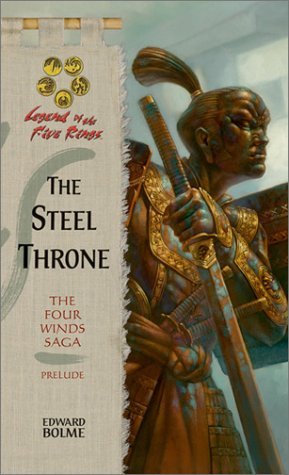
The Steel Throne
The Steel Throne serves as a bridge between the Clan War saga and the Four Winds saga.
This will be the last novel I will review for a while as I still don't have Wind of Honor or Wind of Truth.
The setting of this novel is the War of Spirits, a period which I was always very interested in but never got much development because of a lawsuit. Apparently, though, next year AEG is going to release a sourcebook, Imperial Histories, which will detail this era among others.
I'm actually a bit pissed off I completely missed this. I don't know if I had any chance to get selected or at least be a running candidate, but I would have liked to try...
As to the novel itself, I was very pleasantly surprised.
Characterization is very good, Hantei XVI, Toturi, Hida Tsuneo and Akodo Kaneka being particularly well done. Tsudao was the only character which got altered substantially from her traditional depiction.
In this novel she's dumb as a brick... And I don't mean in the Good is Dumb kind of way, but rather the Full Retard kind of way...
Incidentally, Kaneka is awesome in this novel. Too bad he ended up in Jesse Lebow's hands, then fell prey to AEG's "Rokugan must have a Shogun" fever, AND then had abridge Khan dropped on him. Alas poor Scrappy...
It is not without problems though. The novel spans 20 years, roughly one per chapter, which means that the action feels disjointed at times, and some plot are left underdeveloped or unexplained. The Dragon clan involvement is also awkward with Tamori's power seeming to be a bit too widespread.
Then there is Kitsu Motso's death... I'm still undecided if self-beheading by spinning no-dachi is awesome, or just really dumb.
All in all is a fairly enjoyable book, and if your interested in the War of Spirits it will still be the only source for a while.
This will be the last novel I will review for a while as I still don't have Wind of Honor or Wind of Truth.The setting of this novel is the War of Spirits, a period which I was always very interested in but never got much development because of a lawsuit. Apparently, though, next year AEG is going to release a sourcebook, Imperial Histories, which will detail this era among others.
I'm actually a bit pissed off I completely missed this. I don't know if I had any chance to get selected or at least be a running candidate, but I would have liked to try...
As to the novel itself, I was very pleasantly surprised.
Characterization is very good, Hantei XVI, Toturi, Hida Tsuneo and Akodo Kaneka being particularly well done. Tsudao was the only character which got altered substantially from her traditional depiction.
In this novel she's dumb as a brick... And I don't mean in the Good is Dumb kind of way, but rather the Full Retard kind of way...
Incidentally, Kaneka is awesome in this novel. Too bad he ended up in Jesse Lebow's hands, then fell prey to AEG's "Rokugan must have a Shogun" fever, AND then had a
It is not without problems though. The novel spans 20 years, roughly one per chapter, which means that the action feels disjointed at times, and some plot are left underdeveloped or unexplained. The Dragon clan involvement is also awkward with Tamori's power seeming to be a bit too widespread.
Then there is Kitsu Motso's death... I'm still undecided if self-beheading by spinning no-dachi is awesome, or just really dumb.
All in all is a fairly enjoyable book, and if your interested in the War of Spirits it will still be the only source for a while.
Sunday, 2 January 2011
The Lion
The final novel in the Clan War, The Lion wraps up with the Day of Thunder.
This update took a bit longer than usual because of the usual holiday rush, and because the novel itself is not that interesting.
Mind you I don't mean it's bad. It's just so incredibly average you don't really want to keep reading other than to ocupy your time during a commute or something like that.
You can also do a drinking game with it. Drink every time lion-headed katana...
It does get better towards the end, during the Day of Thunder proper, but up until that point it seems as nearly every moment of character development must come during or after a fight which make the first two thirds of the book a bit disjointed because it looks like battle scenes are being thrown around just to set the mood.
Comparing it with the other books in the saga this one is probably the middle of the pack. Undoubtfully better than the The Unicorn or The Phoenix, it struggles with The Crane depending on the readers particular taste, but definitely worse than The Crab, The Dragon and The Scorpion.
Sullivan seems to have completely overcome his fascination with natto though.
This update took a bit longer than usual because of the usual holiday rush, and because the novel itself is not that interesting.
Mind you I don't mean it's bad. It's just so incredibly average you don't really want to keep reading other than to ocupy your time during a commute or something like that.
You can also do a drinking game with it. Drink every time lion-headed katana...
It does get better towards the end, during the Day of Thunder proper, but up until that point it seems as nearly every moment of character development must come during or after a fight which make the first two thirds of the book a bit disjointed because it looks like battle scenes are being thrown around just to set the mood.
Comparing it with the other books in the saga this one is probably the middle of the pack. Undoubtfully better than the The Unicorn or The Phoenix, it struggles with The Crane depending on the readers particular taste, but definitely worse than The Crab, The Dragon and The Scorpion.
Sullivan seems to have completely overcome his fascination with natto though.
Wednesday, 15 December 2010
The Dragon
Like The Crab before I approached the The Dragon with a fair dose of apprehension. I'm a complete and utter Dragon fanboy, and the Dragon by their very nature is open ground for some of the worst sins of writing and characterization.
To put it simply, I fully expected to hate this novel.
Fortunately it's not as bad as I expected.
It is full of infuriating moments, but you can actually get past them.
I would actually like to know if this was writen after Enlightened Madness or if the Tamashii debacle was something that was planned well in advance with WotC still in the loop, because the first chapter, or rather the epilogue seem a bit of a sendup to it. I think the novel predates the story by about a year, but I might be wrong.
Basically the novel follows Hitomi's path during the Clan War and her quest for vengeance against Yakamo, with Daini's contact with the Naga as a sub-plot.
Hitomi is a fairly one-dimensional character, but overall does manages to keep the reader interested in her misadventures. It is a pity though that her main foil for her is Mirumoto Yukihera, not because it's obscure CCG character (in fact he may not even be the same character), but because Ree Soesbee, unfortunately, decided to make him a complete monster designted villain. Apparently we are really supposed to be rooting for Hitomi and the kami forgive us if we think she might be monomaniacal. Kitsuki Yasu also gets a bit derailed, and Mirumoto Sukune, which has always been hinted as an interesting character, including in this novel, is left in the shadows again, when he could have probably been a more interesting sympathetic foil to Hitomi.
Daini is a somewhat more rounded character, but much of his development occurs off-stage and by the end of the book that is very much an informed attribute. I suspect that is Naga coming of age ritual was supposed to show us that development, but if that is the case, then in my opinion it failed, mostly because while we are told the ritual was a sucess, it reads very much like a failure. Daini did not achieve any sort of enlightenment, he just didn't fail fast enough not to be enlightened...
Then there are the little quibles, or not so little in the case of the passage of time. Apparently Ree Soesbee is a firm believer of time moving at the speed of plot. No problem with that, except when two characters need to perform different tasks, one taking a few minutes, and the other a few months. They meet just before starting those tasks, and meet again immediately after finishing those tasks...
The hyperbole I used for emphasis above is much less exagerated than what you might think if you haven't read the novel. I have to wonder if Ree Sesbee has a grasp of time at all...
Oh, and incidently, obi are not used to keep armour in place. In fact armour doesn't work that way at all...
In the end this is a fairly enjoyable novel though. It's not boring like The Unicorn, or pointless like The Phoenix. It's main problem is that it could have been so much better. It has quite a few interesting premises that are not followed through.
To put it simply, I fully expected to hate this novel.Fortunately it's not as bad as I expected.
It is full of infuriating moments, but you can actually get past them.
I would actually like to know if this was writen after Enlightened Madness or if the Tamashii debacle was something that was planned well in advance with WotC still in the loop, because the first chapter, or rather the epilogue seem a bit of a sendup to it. I think the novel predates the story by about a year, but I might be wrong.
Basically the novel follows Hitomi's path during the Clan War and her quest for vengeance against Yakamo, with Daini's contact with the Naga as a sub-plot.
Hitomi is a fairly one-dimensional character, but overall does manages to keep the reader interested in her misadventures. It is a pity though that her main foil for her is Mirumoto Yukihera, not because it's obscure CCG character (in fact he may not even be the same character), but because Ree Soesbee, unfortunately, decided to make him a complete monster designted villain. Apparently we are really supposed to be rooting for Hitomi and the kami forgive us if we think she might be monomaniacal. Kitsuki Yasu also gets a bit derailed, and Mirumoto Sukune, which has always been hinted as an interesting character, including in this novel, is left in the shadows again, when he could have probably been a more interesting sympathetic foil to Hitomi.
Daini is a somewhat more rounded character, but much of his development occurs off-stage and by the end of the book that is very much an informed attribute. I suspect that is Naga coming of age ritual was supposed to show us that development, but if that is the case, then in my opinion it failed, mostly because while we are told the ritual was a sucess, it reads very much like a failure. Daini did not achieve any sort of enlightenment, he just didn't fail fast enough not to be enlightened...
Then there are the little quibles, or not so little in the case of the passage of time. Apparently Ree Soesbee is a firm believer of time moving at the speed of plot. No problem with that, except when two characters need to perform different tasks, one taking a few minutes, and the other a few months. They meet just before starting those tasks, and meet again immediately after finishing those tasks...
The hyperbole I used for emphasis above is much less exagerated than what you might think if you haven't read the novel. I have to wonder if Ree Sesbee has a grasp of time at all...
Oh, and incidently, obi are not used to keep armour in place. In fact armour doesn't work that way at all...
In the end this is a fairly enjoyable novel though. It's not boring like The Unicorn, or pointless like The Phoenix. It's main problem is that it could have been so much better. It has quite a few interesting premises that are not followed through.
Monday, 6 December 2010
The Crab
I have to admit I aproached The Crab with some trepidation.
The Crab clan and characters are often depicted as mere stereotypes, and sterotypes I don't like at that.
Fortunately my fears were unfounded.
While there are quite a few things I don't like, there is a lot more that I like.
This novel covers Kisada's disgruntlement with the Empire through the Scorpion Coup and Yakamo's feud with Hitomi culminating in his landing at Otosan Uchi.
This is done mostly through the eyes of Kisada, Sukune and Yakamo each of whom is well characterized. In fact, most characters are, with the exception of Kuni Yori, which pretty much falls into a stereotypical Evil Vizier role.
Yori even has his Evil Tower of DOOM.
Speaking of Yori, I really disliked how magic was handled in this novel. It has much of the same problems it had in The Phoenix, but I believe them to be far less excusable here.
Surprisingly, the fight scenes, were another place where I think the writing failed. For the most part it managed to avoid the unstopable badass complex, which is no mean feat considering this book stars both Kisada and Yakamo, but still there were quite a few problems, like weapons and armour not working the way they are supposed to (altough the worst I've seen so far is in The Dragon), and tactics that make no sense. On the other hand Stan brown is refreshingly accurate in regards to logistics and movement rates.
I did notice that there is a significant drop in the quality and pacing of the writing in the last third of the book which is where most of these problems can be found.
Overall though this was a rather entertaining book. It's a shame there is a noticeable drop in the writing quality by the end of the book and that Yori was cast in the flat out evil coucilor role, but this was made without making Kisada look too much of a fool.
I easily recommend this one to any L5R fan.
The Crab clan and characters are often depicted as mere stereotypes, and sterotypes I don't like at that.
Fortunately my fears were unfounded.
While there are quite a few things I don't like, there is a lot more that I like.
This novel covers Kisada's disgruntlement with the Empire through the Scorpion Coup and Yakamo's feud with Hitomi culminating in his landing at Otosan Uchi.
This is done mostly through the eyes of Kisada, Sukune and Yakamo each of whom is well characterized. In fact, most characters are, with the exception of Kuni Yori, which pretty much falls into a stereotypical Evil Vizier role.
Yori even has his Evil Tower of DOOM.
Speaking of Yori, I really disliked how magic was handled in this novel. It has much of the same problems it had in The Phoenix, but I believe them to be far less excusable here.
Surprisingly, the fight scenes, were another place where I think the writing failed. For the most part it managed to avoid the unstopable badass complex, which is no mean feat considering this book stars both Kisada and Yakamo, but still there were quite a few problems, like weapons and armour not working the way they are supposed to (altough the worst I've seen so far is in The Dragon), and tactics that make no sense. On the other hand Stan brown is refreshingly accurate in regards to logistics and movement rates.
I did notice that there is a significant drop in the quality and pacing of the writing in the last third of the book which is where most of these problems can be found.
Overall though this was a rather entertaining book. It's a shame there is a noticeable drop in the writing quality by the end of the book and that Yori was cast in the flat out evil coucilor role, but this was made without making Kisada look too much of a fool.
I easily recommend this one to any L5R fan.
Sunday, 5 December 2010
The Phoenix
How shall I put this nicely?
I hated this book.
It made The Unicorn look good in comparison.
It's still a work of art compared to Wind of War though!
I usually don't like how magic is portrayed in most fantasy novels and started reading this novel fully aware of that and trying to aoid making any judgment based on that, but while I didn't like how magic was depicted I wish that was the only problem it has.
The plot concerns Tadaka's efforts to uncover Junzo's ploys in the Shadowlands, and the unlocking of the Black Scrolls by the Council.
There is also a romantic sub-plot involving Isawa Kaede and Seppun Ishikawa (already started in The Scorpion), that isn't that interesting, and, if I remember correctly, will never get any kind kind of resolution.
What I find most puzzling is that Sullivan had made The Scorpion characters rather compelling, but in this book e never managed to make them anything other than bland. There are a few exception, Ob the mujina, but he is a comedic sidekick without much depth to it, as well as Kaede and Ishikawa but with no real development from what they already were in the Scorpion.
All other characters seem to be nothing else but spell-slinging automatons with little individuality. Tadaka seems little more than a plot expository device, Ujimitsu never goes beyond an in-universe joke. The reader is never given a reason to care about these characters.
The only moment of emotional depth was the Destruction of the Long Tail Nezumi. This part of the plot was extremely powerful and well done, but ended up highlighting the vapidity of the rest of the book.
On the other hand it seems Sullivan oercame his fascination with Natto writing this book. There is only one mention to the stuff.
Not related to the plot itself, but The Phoenix is the first novel that include a map of Rokugan. It has some interesting choices, Kyuden Kakita is put near Beiden Pass, about the same place where, canonically, Shiro Matsu is usually put and make it's sacking far more logic. Another difference is that in this map the Crane have no lands bellow the Spine of the World either, which kind of raises the question on where Asahina lands are.
Sullivan also continues his tradition of creating a new family. Beside the aforementioned Long Tail nezumi tribe, there is also the Heike vassal family of the Phoenix, which is similar in concept to the Morehei of the Crane.
In the end I wouldn't recommend this book to anyone. Completist or Phoenix diehards might want to get it, but you've been warned!!!
I hated this book.
It made The Unicorn look good in comparison.
It's still a work of art compared to Wind of War though!
I usually don't like how magic is portrayed in most fantasy novels and started reading this novel fully aware of that and trying to aoid making any judgment based on that, but while I didn't like how magic was depicted I wish that was the only problem it has.The plot concerns Tadaka's efforts to uncover Junzo's ploys in the Shadowlands, and the unlocking of the Black Scrolls by the Council.
There is also a romantic sub-plot involving Isawa Kaede and Seppun Ishikawa (already started in The Scorpion), that isn't that interesting, and, if I remember correctly, will never get any kind kind of resolution.
What I find most puzzling is that Sullivan had made The Scorpion characters rather compelling, but in this book e never managed to make them anything other than bland. There are a few exception, Ob the mujina, but he is a comedic sidekick without much depth to it, as well as Kaede and Ishikawa but with no real development from what they already were in the Scorpion.
All other characters seem to be nothing else but spell-slinging automatons with little individuality. Tadaka seems little more than a plot expository device, Ujimitsu never goes beyond an in-universe joke. The reader is never given a reason to care about these characters.
The only moment of emotional depth was the Destruction of the Long Tail Nezumi. This part of the plot was extremely powerful and well done, but ended up highlighting the vapidity of the rest of the book.
On the other hand it seems Sullivan oercame his fascination with Natto writing this book. There is only one mention to the stuff.
Not related to the plot itself, but The Phoenix is the first novel that include a map of Rokugan. It has some interesting choices, Kyuden Kakita is put near Beiden Pass, about the same place where, canonically, Shiro Matsu is usually put and make it's sacking far more logic. Another difference is that in this map the Crane have no lands bellow the Spine of the World either, which kind of raises the question on where Asahina lands are.
Sullivan also continues his tradition of creating a new family. Beside the aforementioned Long Tail nezumi tribe, there is also the Heike vassal family of the Phoenix, which is similar in concept to the Morehei of the Crane.
In the end I wouldn't recommend this book to anyone. Completist or Phoenix diehards might want to get it, but you've been warned!!!
The Crane
The third installment of the Clan War series, and the first one writen by a member of the AEG storyteam.
Probably due to this it's one of the novels that most conforms to the generally acepted canon.
As I expected it also undoes nearly everything that was established in The Unicorn.
It follows the problems of the Crane following the coup, namely the Crane-Lion war, the kidnaping of Hoturi, the sacking of Kyuden Kakita and Kyuden Doji and the final confrontation between Hoturi and his clone.
It's standard gaming novel fare, with Crane characters somewhat Mary Sueish, but not obnoxiously so. In fact the only character that annoyed the heck out of me was Shiba Tsukune.
Do you know what the Phoenix do to keep warm in winter? Really?! Is this all Shiba Tsukune can say? Honestly...
This derailment aside it's a fairly enjoyable book as long as expectations are kept at a modest level.
Probably due to this it's one of the novels that most conforms to the generally acepted canon.
As I expected it also undoes nearly everything that was established in The Unicorn.
It follows the problems of the Crane following the coup, namely the Crane-Lion war, the kidnaping of Hoturi, the sacking of Kyuden Kakita and Kyuden Doji and the final confrontation between Hoturi and his clone.
It's standard gaming novel fare, with Crane characters somewhat Mary Sueish, but not obnoxiously so. In fact the only character that annoyed the heck out of me was Shiba Tsukune.
Do you know what the Phoenix do to keep warm in winter? Really?! Is this all Shiba Tsukune can say? Honestly...
This derailment aside it's a fairly enjoyable book as long as expectations are kept at a modest level.
Friday, 3 December 2010
The Unicorn
The Unicorn by Allison Lassieur is the second book in the Clan War series, and if I said The Scorpion aged badly, then The Unicorn is a saponificating corpse.
I honestly didn't remember it being as bad it is.
Well, ok, calling it a decomposing corpse might be a tad unfair, as this novel is mostly mind-numblingly bland and boring rather than outright bad, and even so it is still miles ahead of Wind of War in terms of quality.
It deals with the struggles of a disgraced Unicorn Battle MaidenOtaku, ahem, sorry, Utaku Tetsuko in dealing with banditry in the Wasting Disease afflicted lands of Rokugan, the efforts of Ide Tadaji to help his friend Doji Hoturi, and the Battle for Beiden Pass from the Unicorn point of view.
I don't know the reason why unlike the other books in the series The Unicorn one doesn't focus on it's respective Thunder, altough I suppose The Scorpion doesn't either (Kachiko still plays a large part unlike Kamoko though). It is possible that there was no original plan to make the Thunders the main characters of the series and it was something that emerged organically from the writers.
Either way using a obscure character is not necessarily bad, the problem is that Lassieur doesn't really give us reasons to care about Tetsuko, and the entire book is a bit of an exercise in futility.
I suspect, looking at the publication dates, that, at least, the first three books were commissioned at the same time and that there was little or no communication between the authors, and that because of that Laussieur chose not to commit herself to develop a plotline that might be invalidated by later releases. If that was the case she did herself a great disservice, as it did left us, if I remember correctly, with a plot that was invlidated by later releases and some pretty important cliffhangers like Ide Tadaji, that got no resolution. Might as well have taken the risk and try to do a memorable book.
Then again this book might have been her attempt at doing that...
Overall I would say this book is mostly of interest to a completist.
It's not horrible, despite a few weird pieces of characterization like the peasants in former Scorpion lands, the Tadaji storyline, or the Otaku being called Utaku at this point in the timeline which is an obvious result of WoTC guidelines. It's just entirely forgetable. Maybe the writer was just trying to establish how the Unicorn are distinct from the other clans but the author ended up with something that seems entirely diconnected from the rest of setting.
I honestly didn't remember it being as bad it is.Well, ok, calling it a decomposing corpse might be a tad unfair, as this novel is mostly mind-numblingly bland and boring rather than outright bad, and even so it is still miles ahead of Wind of War in terms of quality.
It deals with the struggles of a disgraced Unicorn Battle Maiden
I don't know the reason why unlike the other books in the series The Unicorn one doesn't focus on it's respective Thunder, altough I suppose The Scorpion doesn't either (Kachiko still plays a large part unlike Kamoko though). It is possible that there was no original plan to make the Thunders the main characters of the series and it was something that emerged organically from the writers.
Either way using a obscure character is not necessarily bad, the problem is that Lassieur doesn't really give us reasons to care about Tetsuko, and the entire book is a bit of an exercise in futility.
I suspect, looking at the publication dates, that, at least, the first three books were commissioned at the same time and that there was little or no communication between the authors, and that because of that Laussieur chose not to commit herself to develop a plotline that might be invalidated by later releases. If that was the case she did herself a great disservice, as it did left us, if I remember correctly, with a plot that was invlidated by later releases and some pretty important cliffhangers like Ide Tadaji, that got no resolution. Might as well have taken the risk and try to do a memorable book.
Then again this book might have been her attempt at doing that...
Overall I would say this book is mostly of interest to a completist.
It's not horrible, despite a few weird pieces of characterization like the peasants in former Scorpion lands, the Tadaji storyline, or the Otaku being called Utaku at this point in the timeline which is an obvious result of WoTC guidelines. It's just entirely forgetable. Maybe the writer was just trying to establish how the Unicorn are distinct from the other clans but the author ended up with something that seems entirely diconnected from the rest of setting.
The Scorpion
Like I've said a few days ago, I've aquired a few of the L5R novels I didn't had and I've been reading them all, starting with the Scorpion.
The Scorpion is the first of the seven novels dedicated to the Clan War.
It actually deals with the Scorpion Clan Coup rather than with the Clan War proper, with focus on Bayushi Shoju's character.
It's a fairly decent novel, but while I remember enjoying it it doesn't seem to have aged that well.
The writing flows, and characterization is well done. Manipulation scenes are, in my opinion, nearly impossible to do believably, but Kachiko's manipulation of Hatsuko works well enough.
As a bonus point, there is a new family mentioned, the Inoshiro. Unfortunately their affiliation is not explicited, but they seem to be Crane, or possibly Seppun vassals.
Where I think The Scorpion fails is in the managemento of time. The entire planning and execution of the coup feels like it has occured within a period of about 3-4 months which broke my ssupension of disbelief this time around.
I wasn't entirely happy on how the magical aspect of the setting was handled either. It's clear that Stephen Sullivan was trying to keep it toned down, and, to his credit, he was largely sucessful in it, but there were still a few instances where it was used to little narrative advantage.
Finally, why such fascination with natto? At one point it seems Rokugani eat nothing else but natto.
Overall though, it is an enjoyable novel to read, depending on your tolerance for gaming fiction, and L5R fans won't be disappointed.
The Scorpion is the first of the seven novels dedicated to the Clan War.
It actually deals with the Scorpion Clan Coup rather than with the Clan War proper, with focus on Bayushi Shoju's character.
It's a fairly decent novel, but while I remember enjoying it it doesn't seem to have aged that well.
The writing flows, and characterization is well done. Manipulation scenes are, in my opinion, nearly impossible to do believably, but Kachiko's manipulation of Hatsuko works well enough.
As a bonus point, there is a new family mentioned, the Inoshiro. Unfortunately their affiliation is not explicited, but they seem to be Crane, or possibly Seppun vassals.
Where I think The Scorpion fails is in the managemento of time. The entire planning and execution of the coup feels like it has occured within a period of about 3-4 months which broke my ssupension of disbelief this time around.
I wasn't entirely happy on how the magical aspect of the setting was handled either. It's clear that Stephen Sullivan was trying to keep it toned down, and, to his credit, he was largely sucessful in it, but there were still a few instances where it was used to little narrative advantage.
Finally, why such fascination with natto? At one point it seems Rokugani eat nothing else but natto.
Overall though, it is an enjoyable novel to read, depending on your tolerance for gaming fiction, and L5R fans won't be disappointed.
Thursday, 25 November 2010
Novels
Got a few of the L5R novels I've been missing from Noble Knight. Now I only need to find Wind of Honor and Wind of Truth to have the complete line. I'm not sure if I'll comment on them as soon as I can of if I'll do it by comparing the publication dates with the RPG line.
Subscribe to:
Posts (Atom)